A nucleus weighs less than the protons and neutrons it is made of, and the missing mass is the measure of how tightly it is held together. This free nuclear binding energy calculator turns that missing mass into an energy: give it a proton count, a neutron count and a measured atomic mass and it returns BE/A, the binding energy per nucleon, with the total binding energy, the mass defect and the distance to the 8.8 MeV per nucleon ceiling beside it. Point the menu the other way and it runs backwards, working out what such a nuclide would have to weigh.
The mass box wants the atomic mass of the neutral atom, not a nuclear mass. That is not a detail: the formula subtracts Z x M(1H), the mass of Z whole hydrogen atoms, precisely so that the Z electrons inside your figure cancel against the Z electrons inside those. Hand it a nuclear mass and every answer is too large by about Z x 0.511 MeV — for iron-56 that is 13.2856 MeV, or 0.2372 MeV per nucleon. Published ground-state tables quote atomic masses, so a figure copied from one is already the right kind.
Load a real nuclide
Every button writes all four boxes in their default units and points the Solve for menu back at the binding energy per nucleon, so the figures always agree with one another. The line underneath quotes back whatever the widget works out from them, so nothing in it is stored text.
Pick a nuclide above, or type your own numbers.
What Is the Nuclear Binding Energy Calculator?
The nuclear binding energy calculator is a free online tool for the energy that holds one nucleus together. Weigh the protons and neutrons separately, weigh the nucleus they make, and the second figure is always smaller; that shortfall, converted to an energy, is the price of pulling the nucleus back apart into loose nucleons. Give the tool a proton count, a neutron count and a measured atomic mass and it returns the binding energy per nucleon, with the total, the missing mass and the mass number beside it.
One convention decides whether the answer is right, and it is worth settling before anything else. The mass you enter is the mass of a neutral atom, electrons and all, so the formula subtracts the mass of Z whole hydrogen atoms rather than Z bare protons: the electrons then sit on both sides of the subtraction and cancel. Hand it a nuclear mass instead and every answer is too large by roughly Z times 0.511 MeV, which for iron-56 is an error of 13.2856 MeV. Published ground-state tables quote atomic masses, so a figure copied from one needs no adjustment.
The headline is the binding energy per nucleon, because that is the figure that decides which way a nuclear reaction releases energy. Five readings sit beside it. The first is the total binding energy, the whole nucleus taken apart at once, which for helium-4 is 28.30 MeV and for uranium-235 is 1784 MeV.
The second reprints the per-nucleon figure with its trailing zeros intact, which matters because the shared engine drops them from the headline: iron-56 is 8.790 MeV per nucleon and the headline can only show 8.79. The third is the mass defect in unified atomic mass units, to nine decimals, and the fourth is the mass number, which is simply the two counts added. The last reading is how far the answer sits below 8.8 MeV per nucleon, a line nothing in nature crosses.
Those first two readings are the distinction the whole subject turns on, and they rank nuclides in opposite orders. Total binding energy grows with the number of nucleons, so the heaviest nuclei always have the largest totals: uranium-238 carries 1802 MeV against iron-56 at 492.3 MeV. Per nucleon the ranking reverses, 7.570 MeV against 8.790, which is why a heavy nucleus can release energy by splitting and a light one by joining.
Where the top of that curve actually sits is more interesting than textbooks usually admit. Ranked by binding energy per nucleon this tool puts nickel-62 first at 8.795 MeV per nucleon, then iron-58 at 8.792, then iron-56 at 8.790; ranked instead by the lowest atomic mass per nucleon, iron-56 wins. Two of the presets are there so the comparison can be made in two clicks, and the gap, 4.2 keV per nucleon, is roughly 359 times the uncertainty on the two measurements. The iron peak is a plateau a few thousandths of an MeV deep rather than a single winner, and iron-56 is the nuclide diagrams mark because it is the lightest per nucleon and far more abundant.
Every energy stops at four significant figures, and that is a ceiling chosen for consistency rather than a limit of the data: the published uncertainties here run from 0.0002 to 0.0377 keV per nucleon, which would support five or six. Four is still fine enough to separate nickel-62 from iron-56. A mass is a different quantity and is printed to nine decimals, because four significant figures on an atomic mass would read 55.93 u and be useless, so the backwards direction puts its answer in a chip and in the working rather than only in the headline.
Four kinds of entry are declined in words instead of being answered. A proton and neutron count that add to nothing, a negative count, an atomic mass heavier than the free nucleons, and an atomic mass light enough to imply more than 8.8 MeV per nucleon. That last refusal is the most useful thing on the page: a result above the ceiling is not a discovery but a sign that the mass and the counts describe different nuclides. A single proton or a single neutron is declined too, because it comes out at exactly zero and a lone nucleon has nothing to be bound to.
What the tool does not do, it says. There is no decay energy, no half-life, no fission or fusion energy release, no fitted formula for the shape of the curve and no electron binding energy anywhere on the page. A positive binding energy means a nucleus is bound against falling apart into free nucleons, which almost every nuclide is; it says nothing about whether that nuclide is stable against turning into a different one, and nothing about how long it will last.
| Symbol | Quantity | Default unit | Also accepts | Example value |
|---|---|---|---|---|
| Z | Proton number | — | — | 2 |
| N | Neutron number | — | — | 2 |
| M | Atomic mass of the nuclide | u | — | 4.00260325413 |
| BE/A | Binding energy per nucleon | MeV per nucleon | keV per nucleon, J per nucleon | 7.074 |
How to use the nuclear binding energy calculator
- Choose the unknown. The Solve for menu opens on Binding energy per nucleon, and the other choice is Atomic mass of the nuclide. Whichever you pick stops being a box and becomes the answer.
- Type the proton number. It is the atomic number of the element and opens on
2for helium. There is no unit, because it is a count. - Type the neutron number. It opens on
2, and it is the neutron count rather than the mass number. Iron-56 goes in as26and30, never as26and56. - Type the measured atomic mass. It takes u and opens on
4.00260325413 u. It must be the mass of the neutral atom, electrons included. - Read the headline. It carries four significant figures of the binding energy per nucleon. The engine drops a trailing zero, so iron-56 reads
8.79there and8.790in the chip. - Read the total binding energy chip. It is the whole nucleus taken apart:
28.30 MeVat the defaults,492.3 MeVfor iron-56,1784 MeVfor uranium-235. - Read the mass defect chip. It is the mass that went missing, to nine decimals:
0.030376641 uat the defaults. Multiply it by931.49410242and the total binding energy comes back. - Read the ceiling chip. It is the distance below
8.8 MeVper nucleon, which nothing in nature passes:0.009644for iron-56 against0.005444for nickel-62. - Solve backwards for the mass. The binding energy box then accepts MeV, keV or J per nucleon, and the answer is an atomic mass — read it from the first chip, not the headline.
- Open Show working. Three steps: the formula with both constants named, the substitution as far as the mass defect, and the division by the mass number.
This page exists for one step: turning two nucleon counts and a measured mass into the energy that holds that nucleus together. The nuclear binding energy guide is the prose half of it, with the curve set out quantitatively, worked problems of rising difficulty and the misconceptions in full. Where the conversion between mass and energy comes from is a different question and a different page: the guide to E = mc2 is the relation this calculator uses once and never derives.
Three mistakes account for most wrong answers here. Typing the mass number into the neutron box — 56 instead of 30 for iron-56 — describes a nuclide with 82 nucleons and gets refused, because the mass no longer matches the counts. Entering a nuclear mass instead of an atomic one is the next, and it inflates every answer by about Z x 0.511 MeV. Last comes expecting the backwards direction to hand back exactly the mass you started from, which a four-figure binding energy cannot do.
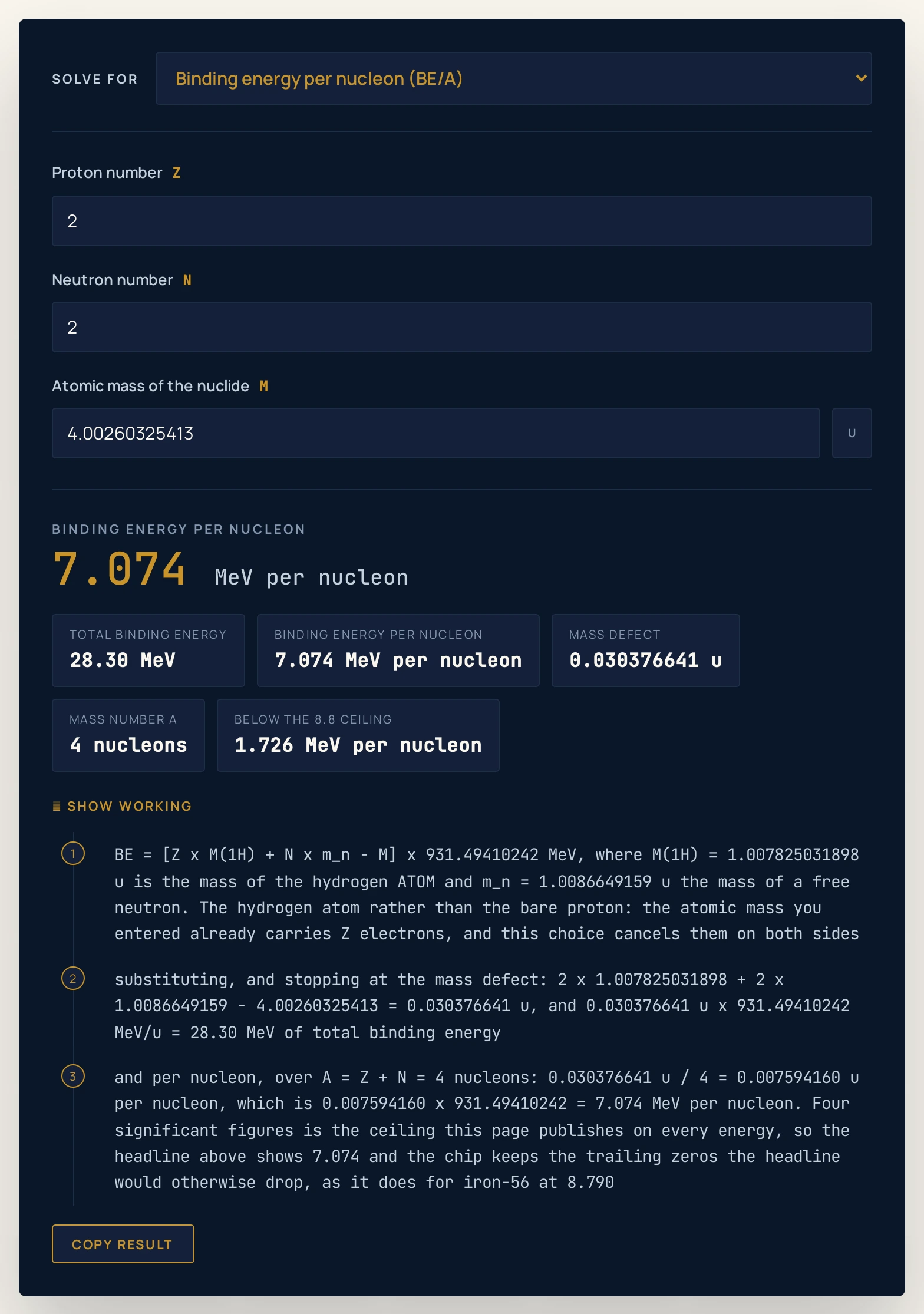
28.30 MeV between them, which is 7.074 MeV each — and the mass that paid for it, 0.030376641 u, is about three quarters of one per cent of the atom.Worked example: change one thing at a time
The table starts at the defaults, climbs the curve from the deuteron to the iron and nickel plateau, falls away again to plutonium, then runs the menu backwards, walks the unit entries and finally reaches the entries the calculator declines. Rows 15 to 19 are the same five nuclides solved in the opposite direction. Every answer and chip cell was read out of the running widget rather than worked out by hand, so where a cell and the tool ever part company, believe the tool.
| Case | Solving for | What you type | Headline answer | Total binding energy | Mass defect |
|---|---|---|---|---|---|
| The page as it opens: helium-4 | Binding energy per nucleon | Z 2, N 2, M 4.00260325413 u | 7.074 MeV per nucleon | 28.30 MeV | 0.030376641 u |
| Hydrogen-2, the most weakly bound nuclide in the reference set | Binding energy per nucleon | Z 1, N 1, M 2.014101777844 u | 1.112 MeV per nucleon | 2.225 MeV | 0.002388170 u |
| Lithium-6 | Binding energy per nucleon | Z 3, N 3, M 6.01512288742 u | 5.332 MeV per nucleon | 31.99 MeV | 0.034346956 u |
| Carbon-12, which defines the unit | Binding energy per nucleon | Z 6, N 6, M 12 u | 7.68 MeV per nucleon | 92.16 MeV | 0.098939687 u |
| Oxygen-16 | Binding energy per nucleon | Z 8, N 8, M 15.99491461926 u | 7.976 MeV per nucleon | 127.6 MeV | 0.137004963 u |
| Iron-56, the nuclide everyone names | Binding energy per nucleon | Z 26, N 30, M 55.934935537 u | 8.79 MeV per nucleon | 492.3 MeV | 0.528462769 u |
| Iron-58, two neutrons heavier | Binding energy per nucleon | Z 26, N 32, M 57.933273575 u | 8.792 MeV per nucleon | 510.0 MeV | 0.547454563 u |
| Nickel-62, the highest in the reference set | Binding energy per nucleon | Z 28, N 34, M 61.928344753 u | 8.795 MeV per nucleon | 545.3 MeV | 0.585363281 u |
| Krypton-86 | Binding energy per nucleon | Z 36, N 50, M 85.91061062468 u | 8.712 MeV per nucleon | 749.2 MeV | 0.804336319 u |
| Lead-208 | Binding energy per nucleon | Z 82, N 126, M 207.976652005 u | 7.867 MeV per nucleon | 1636 MeV | 1.756780014 u |
| Uranium-235, the fission fuel | Binding energy per nucleon | Z 92, N 143, M 235.043928117 u | 7.591 MeV per nucleon | 1784 MeV | 1.915057791 u |
| Uranium-238 | Binding energy per nucleon | Z 92, N 146, M 238.050786936 u | 7.57 MeV per nucleon | 1802 MeV | 1.934193720 u |
| Plutonium-239 | Binding energy per nucleon | Z 94, N 145, M 239.052161596 u | 7.56 MeV per nucleon | 1807 MeV | 1.939804208 u |
| Iron-56 with Z and N typed the wrong way round | Binding energy per nucleon | Z 30, N 26, M 55.934935537 u | 8.734 MeV per nucleon | 489.1 MeV | 0.525103233 u |
| Helium-4 solved backwards from its published figure | Atomic mass | Z 2, N 2, BE/A 7.074 MeV per nucleon | 4.003 u | 28.30 MeV | 0.030377004 u |
| Carbon-12 solved backwards from its published figure | Atomic mass | Z 6, N 6, BE/A 7.680 MeV per nucleon | 12 u | 92.16 MeV | 0.098937824 u |
| Iron-56 solved backwards from its published figure | Atomic mass | Z 26, N 30, BE/A 8.790 MeV per nucleon | 55.93 u | 492.2 MeV | 0.528441349 u |
| Nickel-62 solved backwards from its published figure | Atomic mass | Z 28, N 34, BE/A 8.795 MeV per nucleon | 61.93 u | 545.3 MeV | 0.585392864 u |
| Uranium-235 solved backwards from its published figure | Atomic mass | Z 92, N 143, BE/A 7.591 MeV per nucleon | 235 u | 1784 MeV | 1.915079221 u |
| The same iron with the binding energy typed in keV per nucleon | Atomic mass | Z 26, N 30, BE/A 8790 keV per nucleon | 55.93 u | 492.2 MeV | 0.528441349 u |
| The same iron with the binding energy typed in joules per nucleon | Atomic mass | Z 26, N 30, BE/A 1.408e-12 J per nucleon | 55.94 u | 492.1 MeV | 0.528323804 u |
| A lone proton, hydrogen-1 | Binding energy per nucleon | Z 1, N 0, M 1.007825031898 u | no answer | — | — |
| A lone neutron | Binding energy per nucleon | Z 0, N 1, M 1.0086649159 u | no answer | — | — |
| No nucleons at all | Binding energy per nucleon | Z 0, N 0, M 1 u | no answer | — | — |
| A negative proton count | Binding energy per nucleon | Z -1, N 2, M 1 u | no answer | — | — |
| A negative neutron count | Binding energy per nucleon | Z 2, N -1, M 1 u | no answer | — | — |
| A zero atomic mass | Binding energy per nucleon | Z 26, N 30, M 0 u | no answer | — | — |
| An atomic mass heavier than the free nucleons | Binding energy per nucleon | Z 26, N 30, M 57 u | no answer | — | — |
| An atomic mass light enough to break the ceiling | Binding energy per nucleon | Z 26, N 30, M 55.9 u | no answer | — | — |
| A binding energy above the ceiling, typed in | Atomic mass | Z 26, N 30, BE/A 9 MeV per nucleon | no answer | — | — |
| A zero binding energy, typed in | Atomic mass | Z 26, N 30, BE/A 0 MeV per nucleon | no answer | — | — |
| An entry that parses to infinity | Binding energy per nucleon | Z 26, N 30, M 1e400 | no answer | — | — |
Rows 1 to 5 are the left-hand side of the curve, and helium-4 is the famous anomaly sitting on it. Two nucleons in the deuteron share 2.225 MeV, which is only 1.112 MeV each, and six nucleons in lithium-6 manage 5.332 — yet the four nucleons of helium-4 are held at 7.074 MeV each, above both. That is why alpha particles leave heavy nuclei as a cluster of four rather than one nucleon at a time.
Rows 6 to 8 are the point of the whole page. Iron-56 gives 8.790 MeV per nucleon, iron-58 8.792 and nickel-62 8.795: three nuclides spanning six nucleons and five thousandths of an MeV. The ceiling chip reads 0.009644 for iron-56 against 0.005444 for nickel-62, and the difference between those two figures, 0.0042 MeV per nucleon, is the entire gap between the nuclide textbooks mark and the one that is actually highest.
Rows 9 to 13 come back down the other side, and the two energy columns stop agreeing with each other. Krypton-86 is 8.712 per nucleon, lead-208 7.867, uranium-235 7.591 and plutonium-239 7.56, falling the whole way; the totals meanwhile climb from 749.2 MeV to 1807 MeV. Plutonium-239 holds more than three and a half times the total binding energy of iron-56 and is the least tightly bound nuclide in rows 4 to 13.
Row 14 is an error the tool cannot catch. Iron-56's mass typed with the two counts swapped describes a nuclide of 30 protons and 26 neutrons, and the calculator answers 8.734 MeV per nucleon quite happily, because that combination is physically meaningful even though it is not iron. Nothing on the page knows which element you meant.
Rows 15 to 19 are the same five nuclides run backwards, and they deliberately do not hand back the masses they started from. Helium-4 returns 4.003 u where the entry was 4.00260325413, and carbon-12 returns 12 u in the headline while the chip reads 12.000001862. A binding energy rounded to four significant figures pins the atomic mass only to about 0.0005 x A / 931.494 u, which is a unit in the seventh figure, so the backwards direction is a check rather than a measurement.
Row 17 shows the same effect in the energy column. Iron-56 forwards gives a total of 492.3 MeV; the same iron backwards from 8.790 gives 492.2 MeV, because 8.790 multiplied by 56 is not quite the unrounded figure. Both are right to the precision a four-figure input carries, and the forward direction is the one to trust when you have a mass.
Rows 20 and 21 change nothing but the unit. 8790 keV per nucleon is the same entry as 8.790 MeV per nucleon and returns the identical strings, which is worth knowing because published tables quote this quantity in keV per nucleon. 1.408e-12 J per nucleon is the same figure again in joules, and it lands one digit away at 55.94 u because four figures in joules is a coarser entry than four figures in MeV.
Rows 22 to 32 sit outside the domain and are declined there rather than answered. A lone proton and a lone neutron both give exactly zero, there being no second nucleon for either one to hold on to, and zero is not a binding energy. No nucleons at all would mean dividing by a mass number of zero; a negative count is not a count; an atomic mass heavier than the free nucleons would mean a nucleus that weighs more than its parts.
The last three are the interesting ones. An atomic mass of 55.9 u on 56 nucleons implies 9.37 MeV per nucleon, which no nuclide reaches, so it is refused as a wrong input rather than published as a discovery. The same guard works in the other direction, declining a typed-in 9 MeV per nucleon, and anything that parses to infinity is refused explicitly — Infinity > 0 is true, so a sign test alone would publish it.
The no answer rows are what the widget actually does with those entries: the result area prints That combination has no valid solution. Check your inputs.
No chips are drawn beside that message, which is why the last two columns of those rows are dashes rather than figures. It is a refusal rather than a crash, and nothing on this page ever returns a NaN or an infinity.
Formula and symbol reference
One line does all the work. Weigh Z hydrogen atoms and N free neutrons, subtract the measured mass of the atom you actually have, and the difference is the mass defect: Z x M(1H) + N x m_n - M. Multiply it by 931.49410242 and it becomes the total binding energy in MeV; divide that by A = Z + N and it becomes the binding energy per nucleon.
The conversion factor is the whole of the mass-energy relation compressed into one number: one unified atomic mass unit is 931.49410242 MeV/c2, so a mass defect in u becomes an energy in MeV by multiplication alone. That is stated here once and derived nowhere — the E = mc2 calculator is the tool that owns the conversion in general, for any mass and any unit.
Why the hydrogen atom and not the proton? Because the mass you enter belongs to a neutral atom and carries Z electrons with it. Subtracting Z hydrogen atoms brings Z electrons of their own into the sum, where they cancel the ones your figure carried; the bare proton brings none, and the answer comes out low by about Z x 0.511 MeV. The alpha decay energy calculator takes atomic masses for exactly the same reason, and the electron binding energies that this cancellation ignores run from a few eV to tens of keV, far below anything this page prints.
| Symbol | Meaning | SI unit | Values used on this page |
|---|---|---|---|
| Z | The proton number — how many protons the nucleus has, which is the atomic number of the element. A count, so it has no unit | dimensionless | A box with no unit: 2 for helium, 6 for carbon, 26 for iron, 92 for uranium. |
| N | The neutron number — how many neutrons the nucleus has. It is not the mass number, and typing the mass number here is the commonest mistake on this formula | dimensionless | A box with no unit: 2 for helium-4, 30 for iron-56, 143 for uranium-235. |
| A | The mass number, Z + N — the number of nucleons, and the divisor that turns a total into a per-nucleon figure. A chip rather than a box, because it follows from the two counts | dimensionless | A chip: 4 nucleons at the defaults, 56 for iron-56, 235 for uranium-235. |
| M | The measured atomic mass of the NEUTRAL ATOM, electrons included. A nuclear mass entered here would be wrong by Z electron masses, because the formula is written so the electrons cancel | unified atomic mass unit | A box in u: 4.00260325413 is the default, 12 exactly for carbon-12, 55.934935537 for iron-56. |
| M(1H) | The mass of the hydrogen ATOM — a fixed number rather than an input, and the one choice that makes this formula come out right | unified atomic mass unit | Fixed at 1.007825031898 u, read from the IAEA ground-state table rather than from memory. |
| mn | The mass of the free neutron — also fixed rather than an input. A bound neutron weighs less, which is the whole point of the calculation | unified atomic mass unit | Fixed at 1.0086649159 u, from the same IAEA table. |
| BE | The total binding energy — the energy needed to take the whole nucleus apart into free nucleons. A chip rather than the headline, because the engine allows only one output field | MeV | A chip: 28.30 MeV at the defaults, 492.3 MeV for iron-56, 1784 MeV for uranium-235. |
| BE/A | The binding energy per nucleon — the total shared out over A nucleons, and the quantity that decides which way a nuclear reaction releases energy | MeV per nucleon | The headline: 7.074 at the defaults, 8.790 for iron-56, 8.795 for nickel-62. Also takes keV or joules per nucleon as an input. |
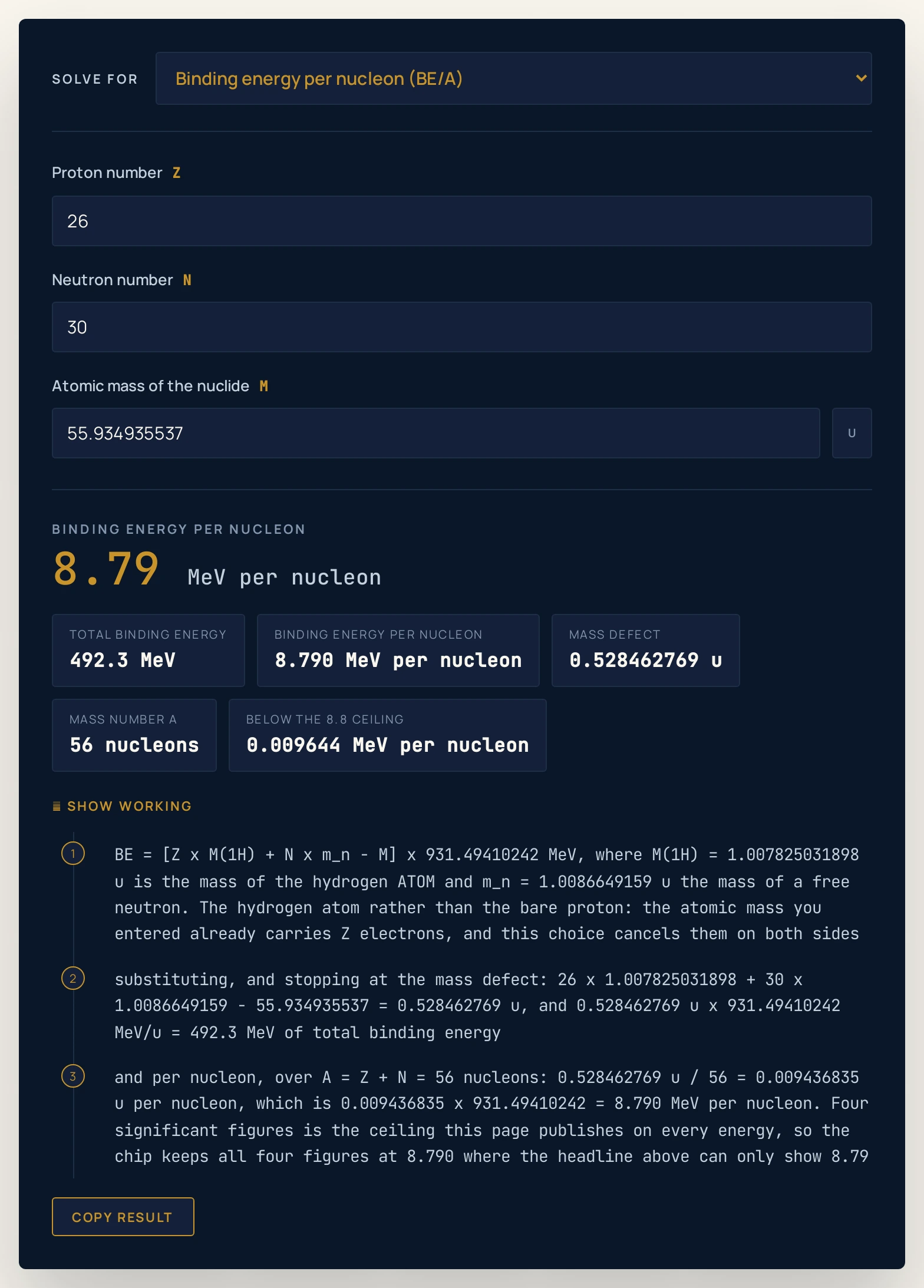
492.3 MeV between them, half a unified mass unit has gone missing, and the headline shows the four-figure 8.790 as 8.79 because the engine drops a trailing zero — the chip beside it keeps it.The physics: why the curve has a top, and where it really is
The strong force that binds nucleons together is short-ranged: a nucleon feels only its immediate neighbours, not the whole nucleus. Add nucleons to a small nucleus and each one gains more neighbours, so the binding energy per nucleon climbs steeply — from 1.112 MeV in the deuteron to 7.976 in oxygen-16. Once a nucleus is big enough for most nucleons to be surrounded, there is nothing left to gain, and the figure flattens out near 8 MeV.
Past the iron region the headline starts to fall, and the proton box is the reason. Each extra proton pushes electrically on every other one, at unlimited range, so that cost climbs as the square of the proton count while the binding it has to beat grows only in step with the number of nucleons. Type a heavy nuclide in and the cost has already won: lead-208 returns 7.867 MeV per nucleon and plutonium-239 7.56.
Those two trends meeting is what makes a peak, and it is the reason both directions of nuclear energy release exist: light nuclei gain by joining, heavy ones gain by splitting, and both are moving towards the same plateau. The fission and fusion guide is where that consequence is worked out, and this page deliberately does none of the reaction arithmetic.
The top is a plateau rather than a single winner. Press the iron-56 and nickel-62 buttons one after the other and the headline moves from 8.79 to 8.795 — nickel-62 is higher, by 0.0042 MeV per nucleon, with iron-58 at 8.792 in between. The gap is real rather than noise: it is about 4.2 keV per nucleon against a combined uncertainty on the two published figures of 0.0117 keV.
And yet textbooks, diagrams and the interactive lab linked below all mark iron-56, with good reason. Divide each atomic mass by its own nucleon count and iron-56 comes out the lightest of every nuclide there is, which is the ranking that decides what stellar burning can reach, and there is far more iron-56 about than nickel-62. Read the two presets together and the peak is a region a few thousandths of an MeV deep, with first place going to whichever of those two questions you asked.
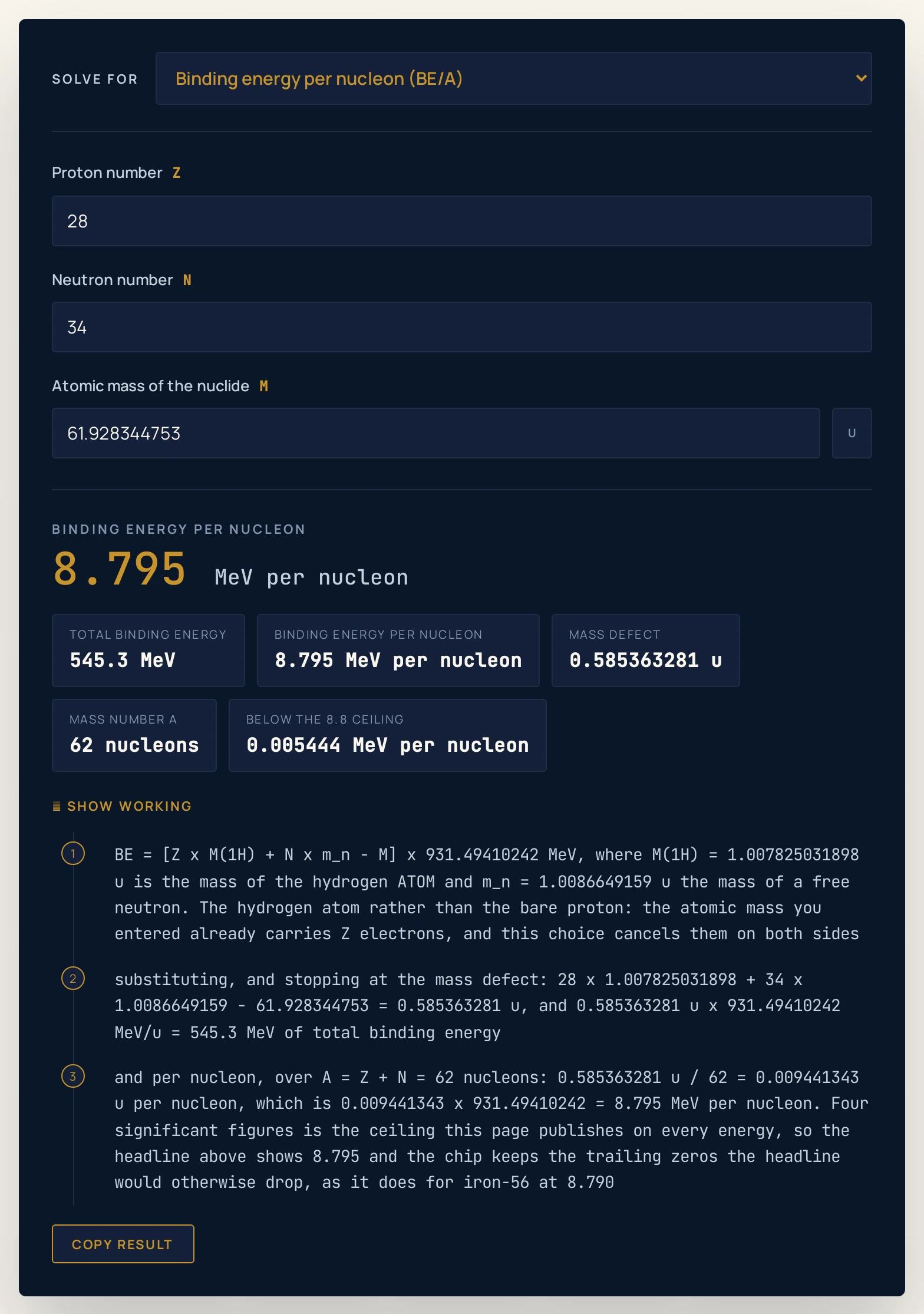
8.79 to 8.795 and the ceiling chip from 0.009644 to 0.005444 — a difference of 0.0042 MeV per nucleon, which is the whole of the argument about where the peak is.Where the nuclear binding energy calculator breaks down
The arithmetic here is exact to the last digit a double can hold, and the inputs are measured to parts in a hundred million. What goes wrong is everything the formula cannot see: which element you meant, whether the nuclide exists, and what it will do next.
- A mass that does not belong to those counts is still answered
- The only masses refused are the ones that break a physical bound: zero or negative, heavier than the free nucleons, or light enough to push past 8.8 MeV per nucleon. Anything in between gets an answer, so iron-56's mass typed against 30 protons and 26 neutrons returns
8.734 MeVper nucleon without complaint. Nothing on the page knows which nuclide you had in mind. - A single nucleon is declined rather than answered with zero
- A lone proton or a lone neutron comes out at exactly zero by construction, because the mass you enter and the mass subtracted are the same number. That is the right physics — with no second nucleon there is nothing for the first one to hold on to — but zero is not a binding energy, so the tool declines it instead of publishing it. The smallest real case is the deuteron at
1.112 MeVper nucleon. - Fractional proton and neutron counts are not rejected
- The two count boxes step in ones, but they will accept 26.5 and return an answer for a nuclide that cannot exist. Refusing non-integers would also refuse a perfectly good entry of
26.0, so the page answers and leaves the judgement to you. Only a negative count is refused outright. - Nothing here says whether the nuclide is stable
- A positive binding energy means a nucleus is bound against falling apart into free nucleons, and almost every nuclide is. It says nothing about alpha or beta decay, which compare one nuclide with another rather than with its own pieces, and nothing about how long it will last. The half-life calculator is the tool for lifetimes, and plutonium-239 at
7.56 MeVper nucleon is firmly bound and still radioactive. - Four significant figures on every energy, and the fifth is a choice not to print
- The published uncertainties on these binding energies run from 0.0002 to 0.0377 keV per nucleon, so the data itself would support five or six figures. Four is the ceiling this cluster sets so that every piece of it agrees, and it is still enough to separate nickel-62 from iron-56. The backwards direction is coarser again, because a four-figure energy pins a mass only to about seven figures.
- Electron binding energies are neglected, deliberately
- Using hydrogen atoms rather than protons cancels the electron masses but not the energy binding those electrons into their atoms, which runs from 13.6 eV in hydrogen to tens of keV in the heaviest elements. That is the standard convention and the error it leaves is thousands of times smaller than the figures printed here. The Bohr model guide and the Bohr model calculator are where atomic binding energies belong.
- No reaction energies, in either direction
- This page takes one nuclide apart into free nucleons. It does not compute what happens when two nuclei join or one splits, and the familiar figure of about 200 MeV per fission is a different quantity from any binding-energy difference, because the prompt release is only part of it and the fragments carry on decaying long afterwards. Deriving it here from these numbers would be wrong twice over, so it is not done.
- No formula for the shape of the curve
- The explanations above are qualitative on purpose. There is a standard fitted expression that reproduces the curve from the nucleon count, the surface area and the proton repulsion, but it is an approximation with adjustable coefficients, and this page would rather use a measured mass than a fit. Every figure here comes from a measurement.
- The 8.8 ceiling is a sanity bound, not a law
- Nothing known exceeds 8.8 MeV per nucleon, and the highest in the reference set behind this page is nickel-62 at 8.7946, so the guard catches wrong inputs rather than unusual nuclides. It is also a deliberately blunt instrument, and how blunt depends on where the nuclide sits. Helium-4 is 1.726 MeV per nucleon below the ceiling, so its mass would have to be 0.0074 u too light before the guard noticed; iron-56 is only 0.009644 below, and 0.00058 u is enough.
- The calculator measures nothing — you supply the mass
- Two counts and one measured mass go in, one subtraction and one multiplication happen, and the answer describes the nuclide you described. The preset names are shorthand for the three figures behind them, and the masses they carry are quoted from a published ground-state table rather than measured here.
Where the nuclear binding energy calculator is actually used
- Settling a homework problem that gives you a mass table
- The standard exercise hands you Z, N and an atomic mass and asks for the binding energy and the binding energy per nucleon, and that is exactly the forward direction. The working prints the mass defect as a separate line, which is usually the step that is marked. Helium-4 comes out at
28.30 MeVand7.074 MeVper nucleon, the pair most textbooks use as their first example. - Checking a figure copied out of a published table
- Ground-state tables quote binding energy per nucleon in keV per nucleon, so the unit menu takes that entry directly. Put the published figure in, solve for the mass, and compare it with the mass the same table gives: agreement in the first six figures means you read the right row. Disagreement in the second figure usually means the two rows were different isotopes.
- Seeing why the curve has a top at all
- Press the five presets in order and watch the two readings separate. The total binding energy climbs the whole way, from
28.30 MeVto1784 MeV, while the per-nucleon figure rises to the iron plateau and then falls back to7.591. The fission and fusion guide is where the consequence of that shape is worked through, and the interactive lab linked at the foot of this page draws the curve itself. - Telling iron from nickel with a number instead of an argument
- The claim that iron-56 is the most tightly bound nuclide is almost right and worth testing. Two clicks give
8.79and8.795 MeVper nucleon, and the ceiling chip puts the gap at0.0042 MeVper nucleon. That is small enough to explain why diagrams label iron and large enough to be certain about. - Separating two isotopes of the same element
- This is the thing the curve on its own cannot do, because the curve is drawn against the mass number. Iron-56 and iron-58 are
8.790and8.792 MeVper nucleon, two thousandths apart, and the only way to get that is from their separate measured masses. The same applies to uranium-235 at7.591against uranium-238 at7.57. - Sanity-checking a mass before using it somewhere else
- A mass that produces a sensible binding energy per nucleon is probably the mass you meant, and one that produces a refusal is not. Because the result is a subtraction of two nearly equal numbers, a mass wrong in its fourth decimal place already moves the fourth figure of the answer. The beta decay energy calculator and the alpha decay tool depend on the same tables, so the check is worth doing before either.
- Looking at the quantity rather than reading about it
- The physics lab library has the interactive versions of all of this, including the binding-energy curve itself with the iron peak marked on it. This page is the arithmetic for one nuclide at a time, to the precision a measured mass allows.
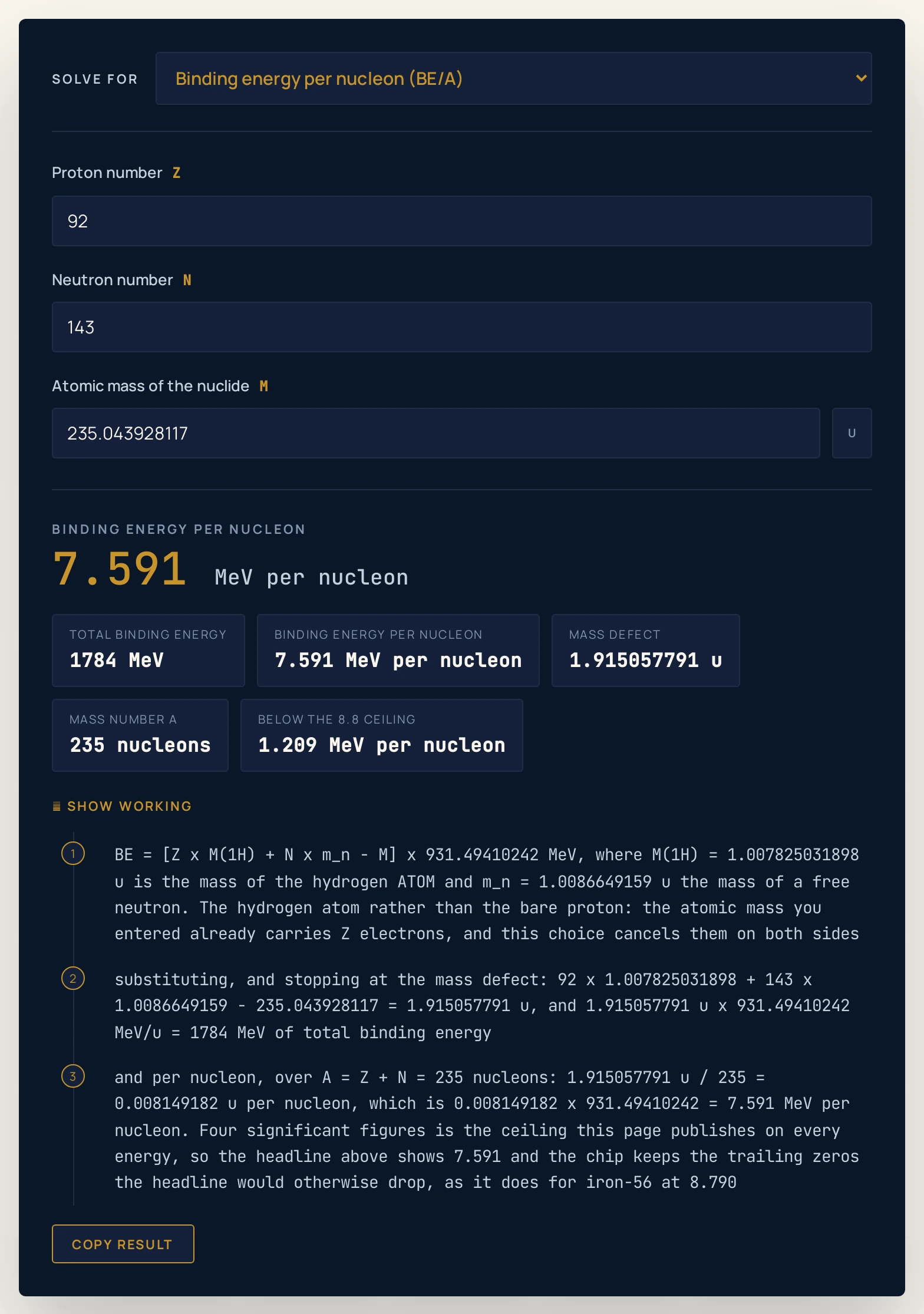
1784 MeV, more than three times iron-56's, while the per-nucleon figure has fallen to 7.591 — nearly two unified mass units have gone missing from the atom, and it is still the loosest-bound nuclide on the preset list.Where to go next
For the curve set out quantitatively, worked problems of rising difficulty and the misconceptions in full, read the nuclear binding energy guide, which this tool is the arithmetic half of. The fission and fusion guide is what the shape of the curve is good for, and the guide to E = mc2 is the mass-energy conversion this page applies once.
Three more posts pick up what this page leaves out. The alpha decay guide is why four nucleons leave together rather than one at a time, the atomic structure guide is what the Z electrons in that atomic mass are doing, and the Bohr model guide is the 13.6 eV kind of binding energy rather than the 8.790 MeV kind.
Five tools sit next to this one. The E = mc2 calculator owns the mass-energy conversion; the alpha decay energy calculator and the beta decay energy calculator take the same atomic-mass tables and compute decay energies instead; the half-life calculator and the decay chain calculator answer how long rather than how much.
The full physics lab library and calculator index are open too.
Frequently asked questions
What is nuclear binding energy?
It is the energy a nucleus absorbs to come apart into free protons and neutrons, and equivalently the energy that was released when it was assembled from them. It shows up as missing mass: a nucleus weighs less than the sum of its parts, and that difference multiplied by the speed of light squared is the binding energy. This calculator works it out from the proton count, the neutron count and the measured atomic mass of the neutral atom.
Why does the calculator use the hydrogen atom mass rather than the proton mass?
Because the mass box wants the mass of a neutral atom, and that figure arrives with Z electrons inside it. Subtracting Z hydrogen atoms at 1.007825031898 u apiece brings in the matching Z electrons, so the two sets cancel and neither is left in the answer. Give the tool a bare-proton figure instead and Z electron masses are left in the sum: iron-56 is then wrong by 13.2856 MeV, or 0.2372 MeV per nucleon, which is three orders of magnitude larger than the precision this page prints to.
What is the difference between total binding energy and binding energy per nucleon?
The total is the whole energy holding the nucleus together, and it grows roughly in step with the number of nucleons, so the biggest nuclei always have the biggest totals. The per-nucleon figure divides that by the mass number and asks how tightly each nucleon is held, which is the quantity that decides stability. Uranium-238 has 1802 MeV of total binding energy against iron-56 at 492.3 MeV, and yet only 7.570 MeV per nucleon against iron-56 at 8.790.
Why will the calculator not print a result above 8.8 MeV per nucleon?
Because nothing in nature reaches it. The highest binding energy per nucleon in the reference set behind this page is nickel-62 at 8.795 MeV per nucleon, and the curve falls away in both directions from there, so a result above 8.8 is not a discovery but a wrong input. In practice it means the atomic mass belongs to a different nuclide from the proton and neutron counts, or that the mass is a nuclear mass rather than an atomic one.
Is nuclear binding energy the same thing as electron binding energy?
No, and the gap between them is not a small one: the nuclear figure is about 646,000 times the atomic one. This tool holds iron-56 at 8.790 MeV for every nucleon, where the electron of a hydrogen atom is held by only 13.6 eV. The nuclear quantity is the only one computed here; the Bohr model calculator is the tool for the atomic side of the word.
Which nuclide is at the top of the binding-energy curve?
It depends which question you are asking, which is why the answer is usually given loosely. Ranked by binding energy per nucleon the reference set behind this page puts nickel-62 first at 8.795 MeV per nucleon, then iron-58 at 8.792 and iron-56 at 8.790; ranked by the lowest atomic mass per nucleon, iron-56 wins instead. The top of the curve is a plateau a few thousandths of an MeV deep rather than a single winner, and iron-56 is the nuclide textbooks and diagrams mark because it is far more abundant and the lightest per nucleon.
Why does the headline sometimes show three figures where the chip shows four?
Because the shared calculator engine formats the headline by dropping trailing zeros, so a four-figure answer ending in a zero loses it: iron-56 is 8.790 MeV per nucleon and the headline can only render that as 8.79. The second chip reprints the same number with the zero intact, and so does the last line of the working. Nothing about the arithmetic changes.
References & formula source
- The relation this page evaluates is BE = [Z x M(1H) + N x m_n - M] x 931.49410242 MeV, with the binding energy per nucleon BE/A = BE / A and A = Z + N. M is the mass of the NEUTRAL ATOM, M(1H) is the mass of the hydrogen ATOM at 1.007825031898 u and m_n the mass of the free neutron at 1.0086649159 u. The hydrogen atom rather than the bare proton is what makes the Z electrons carried by M cancel; electron binding energies inside the atom, which run from a few eV to tens of keV, are neglected and are below the precision this page prints to.
- The two masses above were read from the IAEA Nuclear Data Services ground-state table, fetched for this cluster on 21 October 2026, rather than carried from memory. The conversion factor 931.49410242 MeV per unified atomic mass unit is CODATA 2018. The twenty-three atomic masses behind the presets and the worked table come from the same IAEA fetch and are quoted to the digits that table carries.
- Every binding energy on this page is COMPUTED from an atomic mass and none is quoted from a published binding-energy column. That is deliberate: the independent reference script written for this cluster asserts that the recomputation reproduces the IAEA table's own binding column to a worst deviation of 0.000102 keV per nucleon across all twenty-three nuclides, which is what shows the mass convention above to be the one the published tables use.
- Four reconciliations against figures nobody here chose. The deuteron comes out at 2.225 MeV, against a measured photodisintegration threshold of deuterium of 2.224 MeV. Helium-4 comes out at 28.30 MeV and 7.074 MeV per nucleon, which rounds to the 28.30 MeV and 7.07 MeV per nucleon this site already published in its fission and fusion guide. The alpha decay of uranium-238 reconstructed from binding-energy differences alone agrees with the IAEA's own tabulated decay energy for that decay to 0.0001 MeV, and the deuterium-tritium fusion energy comes out at 17.59 MeV against the canonical 17.6.
- The 8.8 MeV per nucleon refusal is a sanity bound rather than a physical law: the highest binding energy per nucleon in the reference set is nickel-62 at 8.7946, and no nuclide anywhere is known to exceed it. The gap between nickel-62 and iron-56 is 4.2 keV per nucleon against a combined uncertainty on the two figures of 0.0117 keV, so it is resolved data rather than noise.
- Krane, Introductory Nuclear Physics, chapter 3 (nuclear binding energy and the binding-energy curve) and chapter 2 (nuclear masses and the mass defect). Cited as background reading for the definition and the shape of the curve. VERIFY BEFORE USE: these are textbook references rather than links, and no page or edition number is claimed.
- This page computes no decay energy, no half-life, no fission or fusion energy release, no semi-empirical mass formula and no electron binding energy, and none of those is an oversight: each belongs to a page named beside it above. In particular it does no fission arithmetic at all: the familiar figure of about 200 MeV per fission is a different quantity from any binding-energy difference, because it includes the fission fragments' own later radioactive decays as well as the prompt energy release. Every figure quoted in the prose and the tables is a string this calculator printed for the inputs named beside it, or a ratio checked against an independent reference written before this page existed. Where a cell and the running widget ever part company, believe the widget.