Classical Mechanics
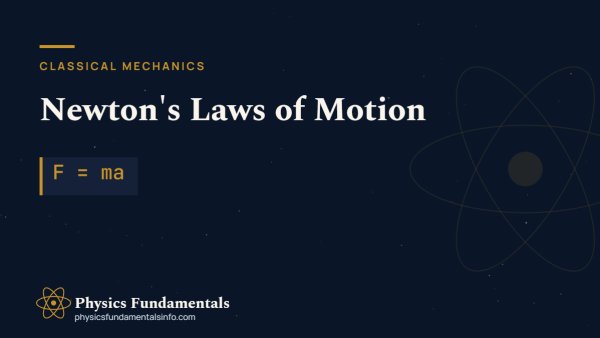
Newton’s Laws of Motion Explained
Newton's three laws of motion explain how forces change movement, summed up by F = ma. Learn each law with worked examples, original diagrams, and an interactive force simulator.
12 min readEvery piece we've published, sorted by date. Each ends with worked problems and a FAQ.
The Physics Fundamentals blog is where each topic gets its long-form explanation: the idea first in plain language, then the mathematics, then worked examples — with an interactive lab and a calculator on the same page so you can test the result with your own numbers. Every article is fact-checked against standard references before it is published.
| Topic | What it covers | Browse |
|---|---|---|
| Electromagnetism | The physics of electric charge and magnetism, and of the fields that carry the force between them. It runs from the current in a wire to the light leaving a star, because visible light is itself an electromagnetic wave. | /blog/category/electromagnetism/ |
| Fluid Mechanics | The physics of liquids and gases, at rest and in motion | /blog/category/fluids/ |
| Kinematics | The branch of mechanics that describes motion | /blog/category/kinematics/ |
| Classical Mechanics | The physics of why motion changes: the forces, energy and momentum that govern everything from a rolling ball to an orbiting satellite. Everything else in physics leans on it. | /blog/category/mechanics/ |
| Modern Physics | What happens when the classical picture breaks down | /blog/category/modern-physics/ |
| Nuclear Physics | The study of the nucleus: what holds it together, how it comes apart, and how much energy that releases. It is where a milligram of matter turns into the output of a power station. | /blog/category/nuclear-physics/ |
| Thermodynamics | The physics of heat, temperature and energy transfer in systems made of enormous numbers of particles | /blog/category/thermodynamics/ |
| Waves and Optics | Oscillations that travel: sound and light, and what happens when a wave meets a boundary, a slit or a lens. The same mathematics describes a guitar string and a radio mast. | /blog/category/waves/ |