The lensmaker equation turns the shape of a lens into a focal length: 1/f = (n - 1)(1/R1 - 1/R2) for a thin lens in air, with a fourth term inside the bracket once the glass has a real centre thickness. This free calculator takes the two radii with their signs, the refractive index, the index of whatever surrounds the lens and the centre thickness, and returns the focal length and the optical power. The same relation is rearranged three more ways, so a target focal length gives you the index or either radius instead.
Two things decide whether you get a number or an answer. A radius is positive when its centre of curvature lies further along the light path, so a biconvex lens is R1 > 0 and R2 < 0 — type both positive and you have described a meniscus. And d = 0 is not a missing value: it is the thin-lens form, exact rather than approximate, which is why that box is never a solve target.
Load a real case
Each button writes the index, both radii, the thickness, the medium index and the diameter into the seven boxes, so the answer changes the moment you press it. The line underneath quotes back whatever the widget then works out, so nothing in it is stored text. All six sets of figures are stated givens chosen to make a point, not measurements of any particular lens.
Pick a case above, or type your own figures.
What Is the Lensmaker Equation Calculator?
The lensmaker equation calculator is a free online tool for the relation that turns a lens's own geometry into a focal length: 1/f = (n - 1)(1/R1 - 1/R2) for a thin lens in air, and 1/f = (n - 1)[1/R1 - 1/R2 + (n - 1)d / (n · R1 · R2)] once the glass has a real centre thickness. Give it the two radii with their signs, the refractive index of the lens, the index of whatever surrounds it and the centre thickness, and it returns f in millimetres with the optical power P = 1000/f in dioptres beside it; point the Solve for menu at the index or at either radius instead and it runs the same relation in that direction.
The signs are not a detail, they are the relation. A radius is positive when its centre of curvature lies further along the path of the light ray, so a biconvex lens has R1 > 0 and R2 < 0. Because the second radius is negative, the subtraction in the bracket becomes an addition and the two faces reinforce each other.
Give both radii the same sign and the bracket cancels instead. Two faces curving the same way are a shell rather than a lens, and with no centre thickness the optical power is exactly zero and the focal length is infinite. That is a real state of this page and the result panel refuses to print it, which is the correct response to an infinity.
The dangerous version of that mistake is the one with a thickness in it. The ordinary wording for an equiconvex lens is that its two surfaces have "the same radius of curvature", which is true of the magnitudes and false of the signs. Read literally it gives two positive radii; at a 5 mm centre thickness the same glass then returns a finite, positive, perfectly plausible 3000 mm against the 50 mm the intended lens would have given, which is sixty times too long. The sign-trap chip computes that comparison in line rather than handing back a silent number.
At n = 1.5 the headline figure is exact, and that is why 1.5 is the index this page opens on. For an equiconvex lens the thin form collapses to the shortcut f = R / [2(n - 1)], and at an index of 1.5 in air that reduces to f = R with no rounding at all: 50 mm radii give a 50 mm focal length and 20 D of power, both checkable in your head. Dropping the factor of two in that shortcut gives 100 mm, exactly twice too long, which is the commonest slip on this formula.
A centre thickness of zero is a value, not a blank. At d = 0 the thickness term is exactly nothing, so the thin-lens form is the whole relation rather than an approximation to it, which is why that box is never a solve target. Type a real thickness and the thickness-cost chip reports what changed, with the direction named: for a converging equiconvex lens the focal length only ever lengthens, so the thin form is always low and never high, while an equiconcave lens in air shortens in magnitude instead.
How low is solved rather than guessed. For an equiconvex lens the gap depends only on the ratio of centre thickness to radius, and the thin form runs 1 per cent low at d = R/16.83 and 10 per cent low at d = R/1.83. The thickness-cost chip reports the figure for whatever you typed, so "negligible" is replaced by a number every time.
The surrounding medium matters as much as the glass. Out of air the factor (n - 1) becomes (n/n1 - 1), and the thickness term scales the same way. For a lens of index 1.42 in a medium of index 1.3375 that contrast falls from 0.42 to about 0.0617, so the same two faces have a focal length nearly seven times longer — which is why the air formula does not describe the one example almost every page on this topic reaches for.
And the shape is reported back to you, read off the two signs alone. Opposite signs with the first positive is biconvex; opposite signs with the first negative is biconcave; two signs that match is a meniscus. A flat face is an infinite radius, which no number box can hold, so plano-convex and plano-concave are named on the page as excluded rather than quietly approximated by a very large radius.
What the page does not do is worth naming as plainly as what it does. It has no object distance, no image distance and no magnification, because those belong to the thin-lens equation and to the lens and mirror calculator, which is linked where the chain hands over. It carries no aberration figure of any kind, no coating, no glass catalogue, no manufacturing tolerance and no dispersion, so a single index means a single wavelength. The one thing it does add beyond the optics is a buildability check: each face sags by R - sqrt(R2 - h2) over a semi-aperture h, so the rim thickness is the centre thickness minus the two sagittas, and a negative result is a knife edge rather than a lens.
| Symbol | Quantity | Default unit | Also accepts | Example value |
|---|---|---|---|---|
| f | Focal length | mm | cm or m, and positive for a converging lens | 50 |
| n | Lens refractive index | — | dimensionless, and 1.5 is the glass value this site publishes | 1.5 |
| R1 | First surface radius of curvature | mm | cm or m, positive when the centre of curvature lies further along the light path | 50 |
| R2 | Second surface radius of curvature | mm | cm or m, and negative for a biconvex lens | -50 |
| d | Centre thickness | mm | cm, input only and never a solve target, and 0 is the thin-lens form exactly | 0 |
| n1 | Surrounding medium index | — | input only, 1 for air, 1.3375 in the watery-medium preset | 1 |
| D | Lens diameter | mm | cm, input only, and it feeds the edge-thickness check alone | 25 |
How to use the lensmaker equation calculator
- Check which half of the chain you need. This page goes from the glass to a focal length; the lens and mirror calculator goes from a focal length to an image position and a magnification. If your problem already hands you
f, you are on the wrong one of the two. - Pick what to solve for. The page opens on the focal length. The Solve for menu also rearranges the relation for the lens index, the first radius and the second radius; whichever you choose becomes the headline and the other three become inputs. The thickness, the medium index and the diameter are never targets, so those three boxes stay on screen in all four directions.
- Get the signs right first. A radius is positive when its centre of curvature lies further along the light path, so a biconvex lens is
R1positive andR2negative. The defaults are50and-50for exactly that reason. The biconvex lens guide works the convention out from scratch and shows what each sign means on a ray diagram. - Enter the two radii. Both boxes take
mm,cmorm. Equal magnitudes with opposite signs make the lens equiconvex whenR1is the positive one, and the working then adds the shortcut linef = R / [2(n - 1)]; hand the minus sign toR1instead and the two magnitudes still match but the lens is equiconcave, withf = -R / [2(n - 1)]. Neither box may be0: a zero radius is a point, not a surface. - Enter the refractive index. The box opens on
1.5, which is the figure this site publishes for glass; the refractive index calculator is where that number comes from if you only have a speed of light in the material. Raise the index and the focal length falls. Lower it towards the medium index and the focal length runs away. - Decide whether thickness matters. Leave
dat0for the thin-lens form, which at that setting is the whole relation rather than an approximation. Type a real thickness and the thickness-cost chip says what changed, as a percentage with the direction named — for a converging equiconvex lens the focal length lengthens, and for an equiconcave one in air it shortens in magnitude. - Read the headline and the six chips. The headline is your quantity to eight significant figures; the chips are the optical power in dioptres, the thin-lens focal length for the same radii, the thickness cost, the shape read off the signs, the edge thickness at your diameter and the sign-trap check. Every one comes from the unrounded state and none from another chip.
- Treat the edge-thickness chip as a buildability test. It subtracts the two face sagittas from the centre thickness, so a negative result is a knife edge rather than a lens. The diameter box feeds that chip and nothing else — it changes no optical figure on the page.
- Expect a refusal where the geometry has no answer. Two radii equal in magnitude and in sign with
d = 0have exactly zero power, sofis infinite and the panel says there is no valid solution. A thickness of zero is never refused.
Two neighbouring ideas are worth separating from this one before you start. The relation here is nothing more than refraction at two spherical surfaces added together, and the single-surface case is Snell's law — the guide to how light bends at a boundary sets out the step this page sums over twice. What the lens then does with a real object is a separate question with its own equation, which the lens equation guide covers and the lens equation simulator lets you move by hand.
The other is the index itself. It is an input here, not something this page derives, and it is a property of the material rather than of the lens — the refractive index guide is where that quantity is argued out, including why the surrounding medium matters as much as the glass.
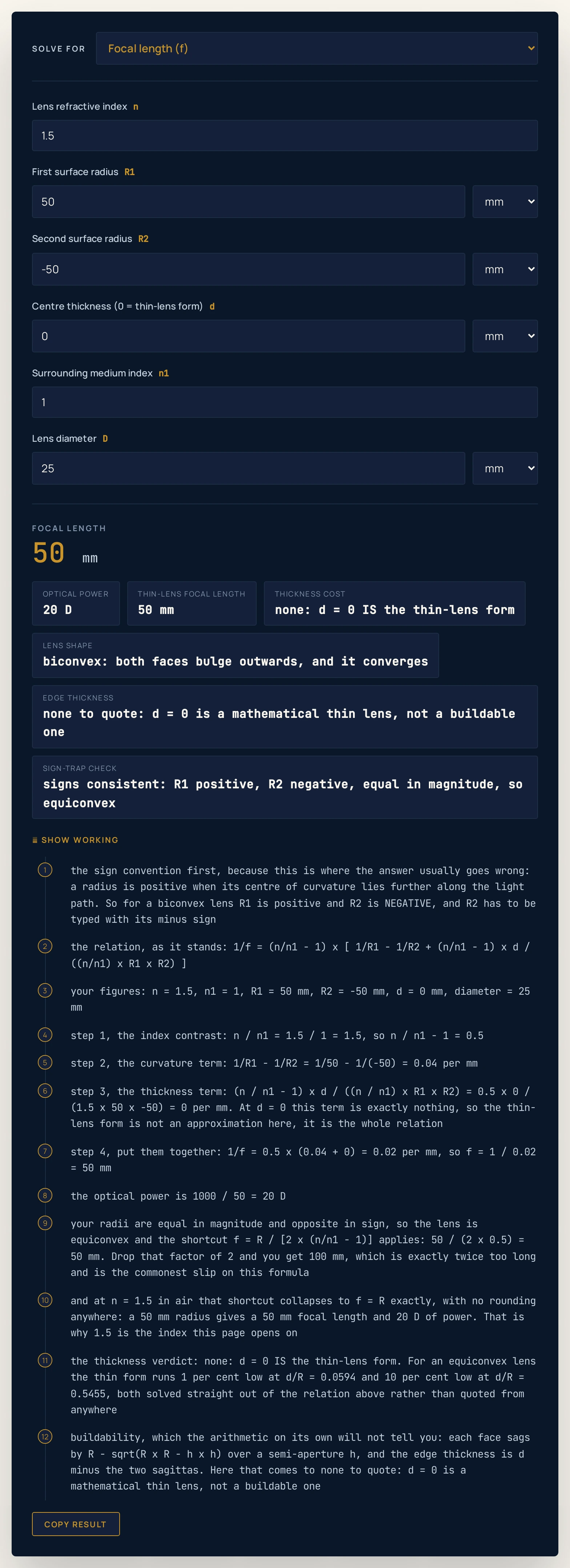
n = 1.5, R1 = +50 mm, R2 = -50 mm and d = 0. The headline reads 50 mm and the power chip 20 D, both exact — at n = 1.5 an equiconvex lens has a focal length equal to its radius of curvature.Worked example: change one thing at a time
The table holds the index at 1.5, the radii at plus and minus 50 mm, the medium at air and the diameter at 25 mm, and moves the centre thickness alone. Every headline and chip cell was read out of the running widget rather than worked out by hand. Where a cell and the tool ever part company, believe the tool.
| Centre thickness in mm | Headline focal length in mm | Optical power | Thickness cost | Edge thickness |
|---|---|---|---|---|
| 0 | 50 | 20 D | none: d = 0 IS the thin-lens form | none to quote: d = 0 is a mathematical thin lens, not a buildable one |
| 1 | 50.167224 | 19.9333 D | 0.33 per cent longer than the thin form | KNIFE EDGE at a 25 mm diameter: not buildable |
| 2.97 | 50.49995 | 19.802 D | 1.00 per cent longer than the thin form | KNIFE EDGE at a 25 mm diameter: not buildable |
| 5 | 50.847458 | 19.6667 D | 1.69 per cent longer than the thin form | 1.8245837 mm at a 25 mm diameter |
| 10 | 51.724138 | 19.3333 D | 3.45 per cent longer than the thin form | 6.8245837 mm at a 25 mm diameter |
| 27.275 | 55.000458 | 18.1817 D | 10.00 per cent longer than the thin form | 24.099584 mm at a 25 mm diameter |
Three things are worth reading off that table. Across the thicknesses it covers — an equiconvex lens in air, from 0 to 27.275 mm on a 50 mm radius — the focal length only ever lengthens as the glass thickens, so over that range the thin form is always low and never high. It is the range and not the shape that makes that true: keep going and the thickness term eventually takes the power through zero, at a thickness of six times the radius, which is the regime the shape table two sections down describes. The optical power falls in step, from 20 D at zero thickness to 18.1817 D at 27.275 mm.
The second row is the one that settles an argument. At 1 mm of centre thickness the focal length has moved by 0.33 per cent, which is a figure most problems can ignore — but the edge-thickness chip already reads KNIFE EDGE, because 1 mm of centre is not enough to carry a 25 mm aperture on 50 mm radii. The optics and the manufacturing disagree about that lens, and only one of the two is visible in the focal length.
The two middle rows are the thresholds, and they are solved rather than guessed: 2.97 mm is R/16.83 and gives exactly 1.00 per cent, and 27.275 mm is R/1.83 and gives exactly 10.00 per cent. Switching the Solve for menu runs any row backwards: from 50.847458 mm at d = 5 the index mode returns 1.5, the first-radius mode 50 mm and the second-radius mode -50 mm.
Formula and symbol reference
| Symbol | What it is | Unit | On this page |
|---|---|---|---|
| f | The focal length: positive for a converging lens, and what the page solves for by default | mm | Box menu reads mm, cm or m. 50 mm is the default, which is exact rather than rounded. |
| n | The refractive index of the lens material. Dimensionless, and strictly positive | none | One scale only. 1.5 is the default, the value this site publishes for glass. The watery medium preset uses 1.42. |
| R1 | The radius of curvature of the first surface the light meets. Positive when its centre of curvature lies further along the light path | mm | Box menu reads mm, cm or m. 50 mm is the default. Never zero. |
| R2 | The radius of curvature of the second surface. Negative for a biconvex lens, and that minus sign has to be typed | mm | -50 mm is the default. Equal in magnitude to R1 and opposite in sign makes the lens equiconvex when R1 is the positive one, and equiconcave when it is not. |
| d | The centre thickness of the lens. Zero is legal and gives the thin-lens form exactly | mm | Never a solve target, so its box is on screen in all four directions. 0 is the default and is a real value, not a blank. |
| n1 | The refractive index of whatever surrounds the lens. Strictly positive | none | Never a solve target. 1 for air is the default; the watery medium preset uses 1.3375. |
| D | The clear diameter of the lens, used only to decide whether it can be made | mm | Never a solve target, and it changes no optical figure on the page. 25 mm is the default. |
| P = 1000/f | The optical power in dioptres, with f in millimetres | D | The first chip beside the answer, never an input: 20 D at the defaults. |
| f = R / [2(n - 1)] | The equiconvex shortcut, which falls out of the thin-lens form when the second radius is minus the first and the first one is positive | mm | A line in Show working whenever the two magnitudes match with opposite signs and R1 is the positive one — two matching positive radii are a meniscus and get the sign-trap line instead. At n = 1.5 it reduces to f = R exactly; the mirror pair gets f = -R / [2(n - 1)]. |
The physics: the signs are the whole relation
Strip the thickness term away and the bracket is just two curvatures subtracted: 1/R1 - 1/R2. Because R2 is negative for a biconvex lens, that subtraction is an addition, and the two faces reinforce each other. Give both radii the same sign and the same subtraction cancels them instead.
That is not a quirk of the formula but a statement about the shape. Two faces curving the same way are a shell, like a watch glass, and a shell of uniform thickness bends light hardly at all. The Wikipedia article on lenses states the consequence outright: two surfaces of equal curvature and equal sign give zero optical power, because the focal length becomes infinite.
What makes this a trap rather than a curiosity is the ordinary wording. “Equiconvex” is usually described as a lens whose two surfaces have the same radius of curvature, which is true of the magnitudes and false of the signs. Read it literally, type 50 into both boxes, and you have asked for the one geometry that has no focal length at all.
The thickness term then decides how bad that is. With d = 0 the panel refuses, which at least tells you something is wrong. With d = 5 mm the same pair of radii returns 3000 mm — finite, positive, weakly converging, and sixty times the 50 mm the lens you meant would have given. That is the number no ranking tool on this keyword flags, and it is why the sign-trap chip computes the comparison for you.
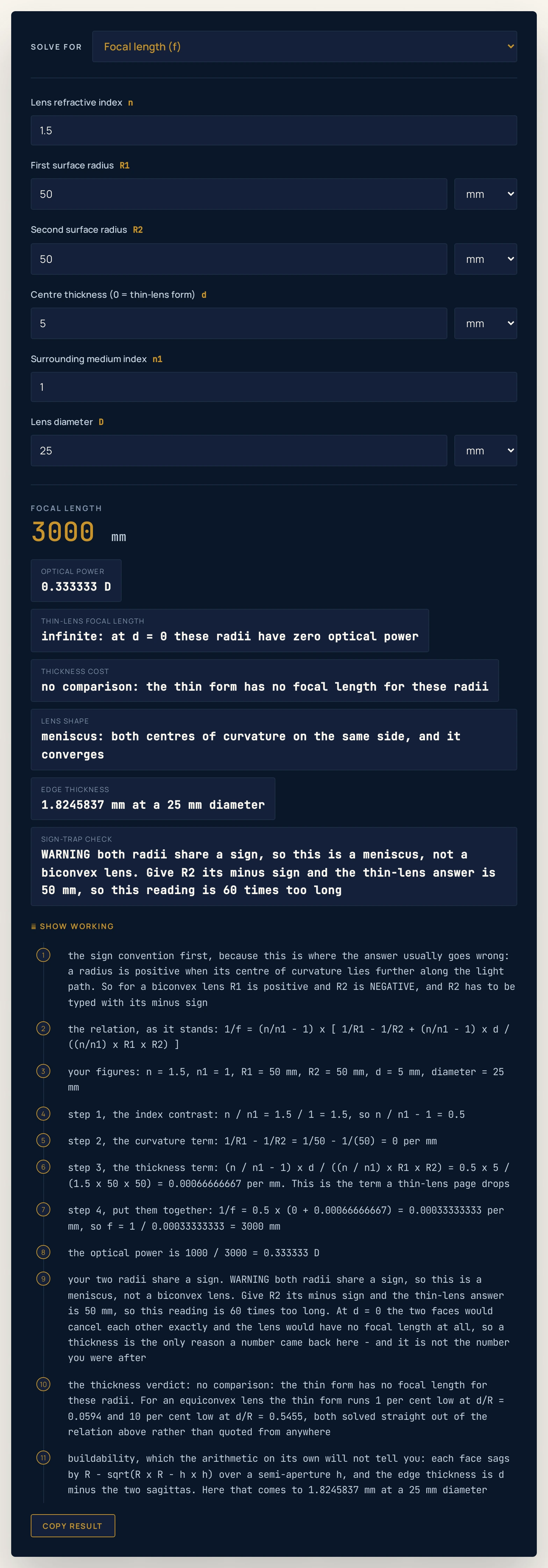
3000 mm, and only the chips give it away: the shape reads meniscus, the thin-lens figure is infinite, and the sign-trap check reports 60 times too long.Where the lensmaker equation calculator breaks down
- Zero optical power cannot be displayed, so it is refused
- Two radii equal in magnitude and in sign with no centre thickness give exactly zero power, and an infinite focal length is not a number any result panel can print. The engine therefore shows its own no-valid-solution message instead, with no chips and no working. That refusal is the answer in that state, and the sign trap preset exists so you can see it happen rather than wonder whether the page broke.
- A flat face is an infinite radius, and no number box can hold one
- Plano-convex and plano-concave lenses are perfectly ordinary, and this page cannot represent either: a flat surface means
1/R = 0, which needs an infinite radius rather than a large one. The inverse directions refuse that answer too, rather than printing something enormous and pretending it is flat. The shape table above names both forms so it is clear they are excluded on purpose. - Two spherical surfaces, and nothing about image quality
- Both faces are treated as parts of spheres and the lens as rotationally symmetric, which leaves out aspheres, cylinders and every real manufacturing departure from a sphere. The page carries no aberration figure of any kind: a focal length says where the light converges on axis and nothing about how sharply. The one aberration claim every explainer makes about biconvex lenses — that they minimise spherical aberration — holds only for symmetric conjugates, with the object and image both at twice the focal length and a magnification of exactly -1, and no number is attached to it here.
- One index, so no dispersion and no colour
- The index box takes a single value, which means a single wavelength. A real lens has a different focal length for every colour, and that spread is what an achromatic pair exists to cancel; nothing on this page models it, and no dispersion data was used in building it. The guide to how light disperses is where the wavelength dependence belongs.
- No object, no image, no magnification
- This page stops at the focal length. Where an image actually forms, whether it is real or virtual and how large it is are the thin-lens equation's business, not the lensmaker equation's, and they live on the lens and mirror calculator. The two are a chain: get
fhere from the glass, then take it there with an object distance. - The diameter answers one question only
- It feeds the edge-thickness chip and nothing else, so changing it moves no optical figure on the page. A diameter wider than twice the smaller radius is refused rather than answered, because that face cannot span the aperture at all. And a knife-edge verdict is about whether the lens can be made, not about whether the arithmetic is right.
Where the lensmaker equation is actually used
- Specifying a lens rather than measuring one
- The focal length is the thing you want and the radii are the thing a workshop can cut, so the useful direction is often backwards: fix the index and one face, ask for a focal length, and read off the other radius. That is the
R1andR2modes on the Solve for menu, and both are one division rather than a search, so neither has an iteration that can fail to converge. - Choosing a material for a focal length you already have
- Fix both radii and ask for the index instead, and the relation becomes a quadratic in the index contrast rather than a linear equation. This page solves it in closed form and takes the smallest positive root, so the answer is always a lens index above the medium index. Some tools run a Newton-Raphson search for the same number; there is no reason to, and an iteration can land on the wrong root.
- Knowing when the thin-lens form is enough
- Most textbook work drops the thickness term, and most of the time that is fine. The honest version of “fine” is a number: for an equiconvex lens the gap depends only on the ratio of thickness to radius, running 1 per cent at
R/16.83and 10 per cent atR/1.83. A short, fat lens is exactly where the thin form stops being usable, which is what the third preset shows. - The same glass in a different medium
- Put a lens in water rather than air and only the index contrast changes, but it changes a great deal: the factor
(n - 1)becomes(n/n1 - 1), and for a lens of index 1.42 in a medium of 1.3375 that term falls from 0.42 to about 0.0617. The same two faces then have a focal length nearly seven times longer, which the last preset puts on screen. Both of those indices come from one published source on the eye's own lens, and this page quotes nothing else about it. - Catching a sign error before it reaches an answer
- In practice the commonest use of a tool like this is as a check on a sign. Two positive radii, a plausible number and no warning is how a wrong focal length gets into a calculation, so the shape chip and the sign-trap chip report the geometry you actually described rather than the one you probably meant. Neither affects the arithmetic; both tell you whether the arithmetic was asked the right question.
| Signs of the two radii | Shape | What that looks like | What the page does with it |
|---|---|---|---|
| R1 positive, R2 negative | Biconvex, also called double convex or convex-convex | Both faces bulge outwards and the lens is thicker at the centre | Converges in air at any ordinary thickness; equiconvex when the two magnitudes match. At n = 1.5 in air the power passes through zero at a centre thickness of six times the radius and the chip then reports that the same two convex faces diverge |
| R1 negative, R2 positive | Biconcave | Both faces curve inwards and the lens is thinner at the centre | Diverges in air; the mirror case of the row above, and equiconcave when the two magnitudes match |
| R1 and R2 both positive | Meniscus | Both centres of curvature lie on the same side of the lens | The sign trap: the two curvature terms subtract instead of adding. Exactly zero power at d = 0 only when the magnitudes match as well as the signs; unequal magnitudes give a real focal length, but for the shell rather than the lens you meant |
| R1 and R2 both negative | Meniscus, the other way round | Both centres of curvature lie on the same side, facing the other way | The same subtraction mirrored: again exactly zero power at d = 0 only when the magnitudes match, and otherwise a real focal length for the shell you typed |
| Either radius infinite | Plano-convex or plano-concave | One face is flat, so one term of the bracket vanishes | Not reachable from these boxes: a number input cannot hold an infinite radius |
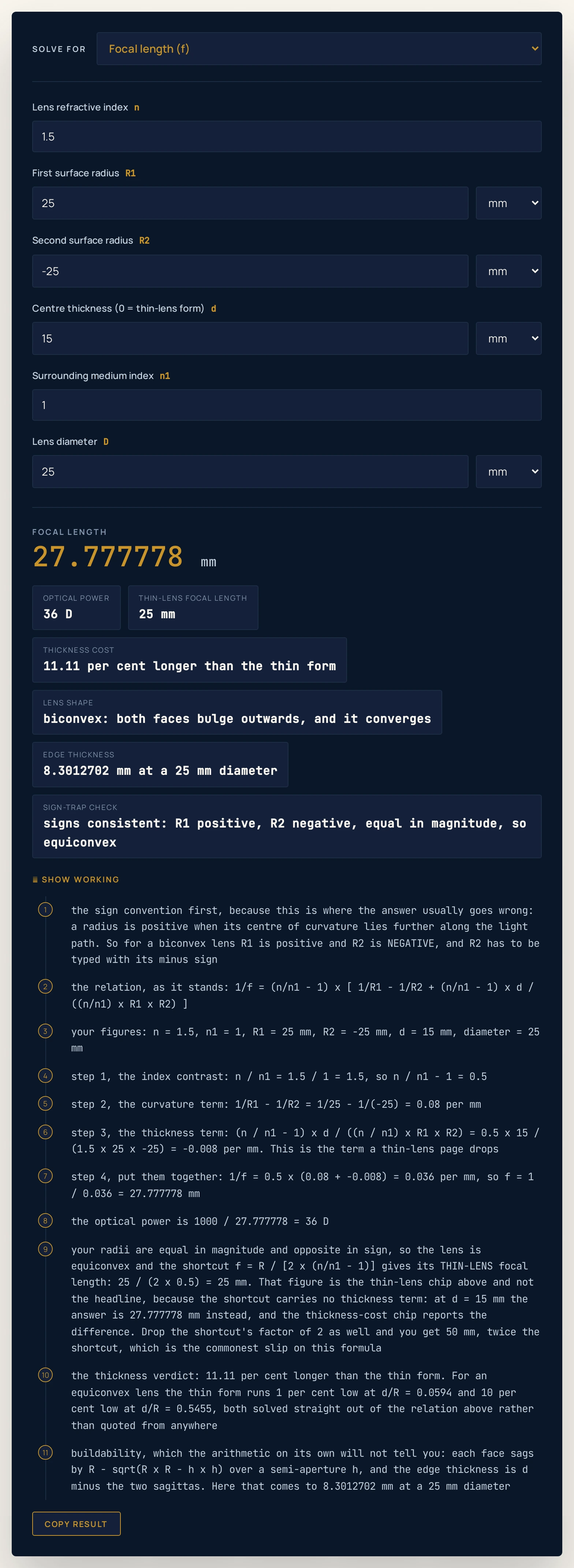
25 mm; the real answer is 27.777778 mm, and the thickness-cost chip reads 11.11 per cent. The edge chip confirms the lens is still buildable, at 8.3012702 mm of rim.Where to go next
For the shape in prose, the ray diagrams and a full set of worked problems, read the biconvex lens guide, which this tool is the arithmetic half of. The concave and convex lens guide is where the two shapes are set against each other, the lens equation guide covers what happens to an object once you have a focal length, and the guide to reflection and refraction puts the single-surface step in its context.
Five tools sit beside this one. The lens and mirror calculator takes the focal length this page produces and finds the image; the refractive index calculator supplies the index it needs; the Snell's law calculator owns the single refraction this relation sums over two surfaces; and the lens equation simulator and the refractive index simulator let you move both effects by hand. The full physics lab library and the calculator index are open too.
Frequently asked questions
What does the lensmaker equation calculator work out?
It turns the shape of a lens into a focal length. Give it the two radii of curvature with their signs, the refractive index of the glass, the index of whatever surrounds it and the centre thickness, and it returns the focal length in millimetres with the optical power in dioptres beside it. The same relation is rearranged three more ways, so you can solve instead for the index or for either radius.
What is the lensmaker equation?
For a thin lens in air it is 1/f = (n - 1)(1/R1 - 1/R2), where n is the refractive index of the lens and R1 and R2 are the radii of curvature of the first and second surfaces. For a lens of finite centre thickness d there is a fourth term, (n - 1)d / (n R1 R2), inside the bracket. In a medium other than air the factor (n - 1) becomes (n/n1 - 1) and the thickness term scales the same way.
Why is the second radius negative for a biconvex lens?
Because a radius is positive when its centre of curvature lies further along the path of the light ray. The first face of a biconvex lens bulges towards the light, so its centre of curvature is beyond the surface and R1 is positive; the second face bulges away, so its centre of curvature is behind the surface and R2 is negative. Both faces are convex and the two radii have opposite signs, which is why the bracket adds rather than cancels.
What happens if I type both radii with the same sign?
You have described a meniscus rather than a biconvex lens, and what the panel does next depends on the magnitudes. Radii equal in magnitude as well as in sign cancel exactly, so with no centre thickness there is no focal length at all and the panel refuses to print one; give that same pair a thickness and a plausible-looking number comes back. Unequal magnitudes return a real, finite focal length straight away, which belongs to the shell you typed rather than the lens you meant, and the sign-trap chip says so in both states.
What is an equiconvex lens and what is the shortcut for it?
An equiconvex lens has two faces of the same curvature, which in this sign convention means radii equal in magnitude and opposite in sign with the first one positive: R1 = +R and R2 = -R. Putting that pair into the thin-lens form collapses it to f = R / [2(n - 1)]. The factor of two is the part people drop, and dropping it makes the answer exactly twice too long. Equal magnitudes alone are not enough: hand the minus sign to R1 instead and the same two magnitudes are an equiconcave lens, f = -R / [2(n - 1)], which the panel names as one.
Does a biconvex lens always have a positive focal length?
In air, at any thickness a real lens would have, yes: both faces converge the light and the focal length comes out positive. Two things break it, and the page reports both rather than asserting the rule. Push the centre thickness far past the radius and the thickness term takes over: at n = 1.5 in air the power passes through zero at a thickness of six times the radius, and beyond that the shape chip says the same two convex faces diverge. In a medium of higher index than the lens the sign flips as well, because the index contrast term goes negative, and the shape chip reports that it diverges. That is the physical reason the medium index is a box on this page rather than a constant.
When does the thin-lens form stop being good enough?
The gap depends only on the ratio of centre thickness to radius, and the calculator solves it rather than guessing. The thin form runs 1 per cent low at a centre thickness of R/16.83 and 10 per cent low at R/1.83, and the thickness-cost chip reports the figure for whatever thickness you typed. For a converging equiconvex lens the thin form is always low and never high, because thickening that shape lengthens its focal length. That is a statement about the shape, not about the formula: other shapes and media reachable from these boxes, an equiconcave lens in air among them, have the same thickness term shorten the focal length in magnitude instead, which is why the chip names the direction rather than assuming it.
Why does the calculator ask for a lens diameter?
Only to answer whether the lens can be made. The two faces sag towards each other, so at some diameter they meet and the rim thickness goes to zero or below, which is a knife edge rather than a lens. The diameter box has no effect at all on the focal length, the power or the thickness cost, and nothing else on this page reads it.
References & formula source
- The relation on this page is 1/f = (n/n1 - 1) times the bracket 1/R1 - 1/R2 + (n/n1 - 1) d / ((n/n1) R1 R2), with every length in millimetres and the optical power reported as 1000/f in dioptres. With the surrounding index set to 1 the bracket is the ordinary air form of the lens maker equation, and with the centre thickness set to 0 it is the thin-lens form. Nothing on this page iterates: the two radius directions are one division each and the index direction is a quadratic in n/n1 - 1 solved in closed form.
- The sign convention is the one the Wikipedia article on lenses states: R1 greater than zero and R2 less than zero indicate convex surfaces, used to converge light in a positive lens. The StatPearls entry on the lensmaker equation puts the same rule the other way round, as a positive radius when the centre of curvature is further along in the path of the light ray and a negative radius when the rays have already passed the centre of curvature. Both were fetched and quote-checked while this page was built.
- The refractive index 1.5 for glass is the value this site already publishes on its own refraction tool, and it is used here in preference to any catalogue figure because an unsourced constant may not ship. It also makes the opening state exact rather than rounded: at n = 1.5 an equiconvex lens has a focal length equal to its radius of curvature, so a 50 mm radius gives 50 mm and 20 dioptres with no rounding anywhere. The two other indices on this page, 1.42 and 1.3375, are both quoted from the StatPearls entry named above.
- The thickness term is Wikipedia air form with the lens index replaced by the ratio of the lens index to the medium index. That substitution is derived rather than assumed: starting from the Gullstrand relation for the power of a thick lens in a uniform medium, with the two surface powers written as the index difference over each radius and the focal length as the medium index over the total power, the thickness term reduces to the square of n/n1 - 1 times d over the product of n/n1, R1 and R2 exactly. The cluster reference run computes both forms for three index pairs and they agree to one part in a million million.
- The two thickness thresholds quoted on this page, 1 per cent low at a thickness-to-radius ratio of 0.0594 and 10 per cent low at 0.5455, are solved straight out of the relation above and are not quoted from anyone. For an equiconvex lens the gap closes to a single coefficient, (n - 1) / 2n, which is exactly one sixth at n = 1.5; the two ratios are that coefficient inverted at the two target errors. No commercial tolerance and no conjugate-ratio window appears anywhere on this page, because every figure of that kind in this keyword set belongs to a vendor product page and none of those were fetched.
- Every chip reading and every cell of the worked table on this page is a string this calculator printed for the inputs named beside it, captured in the cluster test log. The preset states and the screenshot states are stated givens chosen to make a point, and the lens diameters among them are inputs rather than measurements of anything. The one worked case taken from outside is the OpenStax thin-lens example, which the cluster reference run reproduces exactly: a 10.0 cm focal length with the object at 50.0 cm gives an image at 12.5 cm and a magnification of -0.250.
- The edge-thickness arithmetic is elementary geometry rather than optics: a spherical face of radius R sags by R minus the square root of R squared less the semi-aperture squared, and the rim thickness of the lens is the centre thickness minus the two sagittas. It is on the page because the focal length alone will happily describe a lens that cannot be made. The diameter box feeds that one chip and nothing else, and a diameter wider than twice the smaller radius is refused rather than answered, because the face cannot span the aperture at all.
- What this page does not do is worth naming as plainly as what it does. It has no object or image distance, so it says nothing about where an image forms; that is the thin-lens equation and it belongs to the lens and mirror calculator, which is linked where the chain hands over. It carries no aberration figure of any kind, no coating, no glass catalogue and no manufacturing tolerance, and it treats both faces as spherical and the lens as rotationally symmetric.
- Hecht, Optics, chapter on thick lenses and lens systems (the lensmaker relation, the sign convention and the thickness term).
- Jenkins and White, Fundamentals of Optics, chapter on thin lenses (the equiconvex special case and the two-surface derivation).
- Further reading: Lens — Wikipedia