Power-to-weight ratio is an engine's or vehicle's power divided by its mass — how much power drives each kilogram. This free calculator solves for the ratio, the power or the mass, and shows every step.
What Is the Power-to-Weight Ratio Calculator?
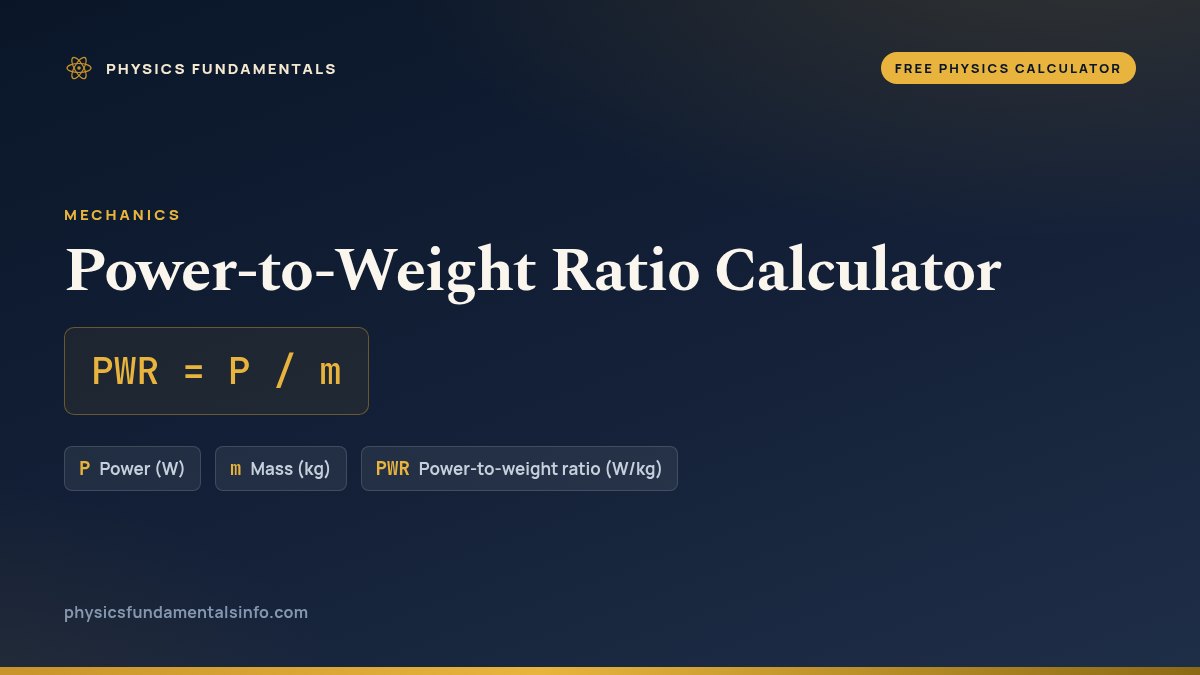
The Power-to-Weight ratio calculator is a free online tool built on the formula PWR = P / m. Enter the values you already know, in whichever units suit you, and it solves for power-to-weight ratio, power or mass and shows every step of the substitution. Power-to-Weight Ratio is power divided by mass — the key performance ratio for engines and vehicles.
| Symbol | Quantity | Default unit | Also accepts | Example value |
|---|---|---|---|---|
| P | Power | W | kW, MW, hp | 100000 |
| m | Mass | kg | t, lb | 1000 |
| PWR | Power-to-weight ratio | W/kg | kW/kg, hp/t | — |
How to calculate power-to-weight ratio
The power-to-weight ratio is one of the most useful single numbers in performance engineering, and it could hardly be simpler to work out: divide the power by the mass, PWR = P / m. In SI units that gives watts per kilogram (W/kg); the automotive world usually quotes horsepower per tonne (hp/tonne) instead, but it is the same idea in different clothes. A higher ratio means quicker acceleration and better climbing, because more power is available to move each kilogram of machine.
There are three steps. First, choose whether you want the ratio, the power or the mass in the Solve for menu. Second, enter the two values you know — power in W, kW, MW or hp, and mass in kg, tonnes or pounds. Third, read the answer with the worked steps, which show the formula, your numbers substituted in, and the result with units. The heavier lifting of Newton's second law (F = m·a) explains why a bigger ratio accelerates harder, while the power calculator covers where the power figure itself comes from.
One subtlety is worth flagging. Physicists use mass in kilograms here — the word "weight" in the name is colloquial. True weight is a force, equal to mass times gravity (m·g), measured in newtons. The closely related thrust-to-weight ratio used for aircraft and rockets, F / (m·g), genuinely divides a force by a weight, which makes it dimensionless. For a plain-language definition of these terms, see the physics glossary.
Worked example
Take a 100 kW engine — about 134 hp — fitted to a 1000 kg car. The power-to-weight ratio is PWR = P / m = 100000 W / 1000 kg = 100 W/kg, which is roughly 134 hp per tonne. Notice how the ratio scales linearly with both inputs: halving the mass to 500 kg, or doubling the power to 200 kW, each doubles the ratio to 200 W/kg. That is why race teams chase every kilogram of weight saving as eagerly as extra power.
Why it matters
Acceleration, hill-climbing and agility all scale with power-to-weight, so the ratio is a standard yardstick across motorsport for cars and motorcycles, for aircraft (via the related thrust-to-weight ratio), and for rockets, where it decides whether a vehicle can leave the pad at all. It matters just as much in cycling, where W/kg is the decisive climbing metric — elite riders sustain around 6 W/kg up a mountain pass. Bear in mind, though, that a strong ratio does not by itself set top speed: once a vehicle is moving fast, aerodynamic drag and gearing take over as the limiting factors.
Frequently asked questions
What is a good power-to-weight ratio?
Sports cars sit around 100–150 W/kg (roughly 150–250 hp/tonne), while everyday road cars are nearer 50–75 W/kg. In cycling the numbers are far smaller because a rider is the engine: elite climbers can sustain about 6 W/kg on a long ascent.
How do I convert W/kg to horsepower per tonne?
One horsepower per tonne equals 745.7 W / 1000 kg = 0.7457 W/kg. So to convert W/kg to hp/tonne you multiply by about 1.341 (the reciprocal of 0.7457). For example, 100 W/kg is about 134 hp/tonne.
Is it power-to-weight or power-to-mass?
Strictly it is power-to-mass: the ratio uses mass measured in kilograms, not weight. Weight is a force equal to m·g in newtons, so the popular label "power-to-weight" is just conventional. Physicists and this calculator both use mass.
What is thrust-to-weight ratio?
For jets and rockets the equivalent figure is thrust-to-weight: the thrust force divided by the weight (m·g). It is dimensionless, and a value above 1 means the craft produces more thrust than its own weight and can accelerate straight up.
Does a higher ratio always mean a faster vehicle?
A higher power-to-weight ratio improves acceleration and hill-climbing, but it does not guarantee a higher top speed. Top speed is limited mainly by aerodynamic drag and gearing, which the ratio alone does not capture.
References & formula source
- Halliday, Resnick & Walker — Fundamentals of Physics, Chapter 7–8 (Work, Energy and Power).
- Young & Freedman — University Physics with Modern Physics, §6.4 (Power).
- Bosch Automotive Handbook — vehicle performance and power-to-weight ratio.
- Further reading: Power-to-weight ratio — Wikipedia