Water creeping through sand, soil or rock obeys one linear relation: Q = K·A·(dh/L), in cubic metres per second. This free Darcy's law calculator runs it in five directions — point Solve for at the discharge, the hydraulic conductivity, the cross-sectional area, the head drop or the flow path length — and prints the hydraulic gradient, the Darcy flux, the seepage velocity, the grain-size Reynolds number, the intrinsic permeability and the discharge per day beside the answer. Darcy's law is not the Darcy friction factor, which is pressure loss along a pipe wall and belongs to the friction factor calculator instead.
Capital K here is the hydraulic conductivity, in m/s — it is not the intrinsic permeability. The intrinsic permeability is lower-case k, it is measured in m2, and the two differ by ρg/μ, a factor of 9.773e+6 for water at 20 °C. The calculator prints k as one of the readings beside the answer, so you never have to make that conversion by hand.
Enter the head drop as a positive number. The law is written Q = −K·A·(dh/dl) and the minus sign says only that water runs down the gradient, so this page works in magnitudes and the sign never reaches the answer. A head drop of 0 is accepted when you are solving for the discharge — a hydrostatic column has no gradient, and 0 is the right answer rather than an error.
The porosity box wants the effective porosity, the connected fraction that actually carries flow, and it must lie strictly between 0 and 1. Every other box must be finite and greater than zero in the modes that read it, and the answer is checked as well as the entry — 1e-320 m2 is a positive area, but a discharge divided by it is not a number at all. Solving backwards for the conductivity, the area or the path length needs a head drop above zero, because at a zero gradient every conductivity gives the same zero flow and there is nothing unique to return.
Load a real case
Every button writes all six boxes at once, so whichever quantity the Solve for menu is pointing at, the remaining five already describe the same column. The line underneath quotes back whatever the widget works out from that, so nothing in it is stored text.
These are illustrative conductivities chosen to span the measured range of each material class, not measurements of any named site. Real hydraulic conductivity varies by orders of magnitude within one material name and has to be measured rather than looked up.
Pick a column above, or type your own numbers.

What Is the Darcy's Law Calculator?
The Darcy's law calculator is a free online tool for water creeping through a porous medium — sand, soil, gravel or rock: Q = K·A·(dh/L), in cubic metres per second. Give it the hydraulic conductivity, the cross-sectional area, the head drop and the flow path length and it returns the discharge; point the Solve for menu at any one of those four instead and it runs the same relation in that direction. All five directions return the value they started from, which is what makes the tool usable for reading a permeameter test backwards.
Beside the answer it prints seven readings worked out from the same inputs: the hydraulic gradient, the Darcy flux, the seepage velocity, the factor between those two speeds, the grain-size Reynolds number with a regime word, the intrinsic permeability in square metres, and the same discharge in cubic metres per day. None of the seven is a box, and none of them can be entered. The effective porosity is an input but never a solve target, because it does not appear in the discharge at all.
The Darcy flux is not the speed of the water, and that is the single most useful thing this page prints. The flux q = K·i comes out in metres per second and is traditionally called the Darcy velocity, but it is a discharge divided by the whole area of the face — grains and pores together — so nothing travels at it. The water has only the connected pore space to move through, so it really moves at v = q/n, which is 1/n times faster.
The direction of that error is why the calculator prints both speeds and the factor between them. On the opening column the flux is 0.001000 metres per second and the seepage velocity is 0.003333, a factor of 3.3333. Use the flux where the pore velocity belongs and every travel time comes out 1/n times too long, which predicts water arriving later than it does rather than earlier.
Capital K and lower-case k are two different quantities and the page keeps them apart in words. Capital K is the hydraulic conductivity in metres per second, and it describes the medium and the fluid together; lower-case k is the intrinsic permeability in square metres, and it describes the medium alone. The two differ by the density times gravity over the dynamic viscosity, a factor of 9.773e+6 for water at 20 °C, so the sixth reading converts between them on every answer.
The law needs two lengths rather than a gradient, and the calculator divides one by the other for you. The head drop is the difference between two hydraulic heads read against a single datum, and the flow path length is the distance the water actually travels between them — measured along the path, not across a map. A 1 metre drop over 1 metre of path and a 20 metre drop over 20 metres are the same problem, which the first reading makes obvious by printing the gradient itself.
The regime verdict is a verdict for a grain size the page states rather than one you enter. The grain-size Reynolds number needs a representative grain diameter, and there is no honest way to recover one from a hydraulic conductivity alone, so the page states a reference grain size of 0.50 millimetres — a medium sand — and attaches that qualifier to every verdict it prints. For a much coarser or much finer material the same flux sits at a different grain-size Reynolds number.
Against that stated grain size the ceiling is a flux rather than an abstraction. Below a grain-size Reynolds number of 1 the flow is slow enough that the linear law applies cleanly; experimental tests have shown regimes up to about 10 may still be Darcian; above 10 the inertial losses the law omits begin to matter and it over-predicts the flow. Those two boundaries sit at a flux of 0.002008 and 0.02008 metres per second respectively.
One preset is there to show the calculator printing a number that is not a flow. At the Past the Darcy limit state the grain-size Reynolds number reads 199.2, which is 19.9 times the upper end of the usable band, so the 0.02827 cubic metres per second it returns is what the linear law predicts and not a discharge that would occur. The real flow there is lower, because the losses the linear law leaves out grow with the flux, and the working says so in a step of its own whenever that state is reached.
The page opens on one deliberately round column: a conductivity of 0.001 metres per second through 1 square metre, with a 1 metre head drop over a 1 metre path and an effective porosity of 0.3. That gives a gradient of 1.000, a flux of 0.001000 metres per second and a discharge of 0.001 cubic metres per second, which is 86.40 cubic metres per day. Every box describes the same column, because the engine rebuilds all of them from their opening values whenever the Solve for menu changes.
Two unit conversions on this page run differently from the ones beside them. An area is a length squared, so a square centimetre is one ten-thousandth of a square metre rather than a hundredth, and a hectare is ten thousand of them; a multiplier copied across from a length field is wrong by a factor of a hundred. And both per-day units divide by 86400 rather than by 24, because the groundwater literature quotes conductivity in metres per day and engineering practice quotes discharge in cubic metres per day.
Every box is checked for being a finite number rather than merely for having the right sign, and the answer is checked as well as the entry. An infinity is greater than zero, and an area of 1e-320 square metres is a finite positive number while a discharge divided by it is not a number at all. The effective porosity must lie strictly between 0 and 1: zero would make the pore velocity infinite, and a volume that is entirely pore space is an open channel rather than a porous medium.
One entry the page deliberately does not refuse is a head drop of zero. A hydrostatic column has no gradient and therefore carries no flow, so solving for the discharge there returns exactly zero rather than an error, and the regime word stays Darcian. The three directions that solve backwards for the conductivity, the area or the path length do need a drop above zero, because at a zero gradient every conductivity gives the same zero flow and there is nothing unique to return.
What the page does not compute, stated as omissions rather than as assumptions that happen to hold: a pressure, a pipe flow, an open-channel flow, an unsaturated flow or a transient one. The arithmetic assumes one single conductivity for the whole path, a fully saturated medium, steady flow and a straight path of length L — and a real formation is layered and anisotropic, with a horizontal conductivity far larger than its vertical one, so one number for it is a model of it. Open-channel flow belongs to the Manning equation instead, whose roughness coefficient is also written n and is not the porosity this page asks for.
The five preset columns are illustrative conductivities chosen to span the measured range of each material class, from a clay liner at 1e-9 metres per second to coarse material at 0.1 — a factor of a hundred million. They are not measurements of any named aquifer, dam, landfill or laboratory test: real hydraulic conductivity varies by orders of magnitude within a single material name and has to be measured rather than looked up. The inputs are our choice; only the outputs are computed.
| Symbol | Quantity | Default unit | Also accepts | Example value |
|---|---|---|---|---|
| Q | Volumetric discharge | m³/s | L/s, m³/day | 0.001 |
| K | Hydraulic conductivity, capital K | m/s | m/day, cm/s | 0.001 |
| A | Cross-section normal to flow | m² | cm², ha | 1 |
| dh | Head drop across the path | m | cm, mm | 1 |
| L | Flow path length | m | cm, km | 1 |
| n | Effective porosity, 0 to 1 | — | — | 0.3 |
How to use the Darcy's law calculator
- Start from the two lengths, not from the gradient. Enter the head drop and the path length that drop is spread over, and the calculator divides one by the other for you. The hydraulic gradient
i = dh/Lis the first reading beside the answer. - Choose the unknown. The Solve for menu opens on Discharge, and the other four choices are Hydraulic conductivity, Cross-sectional area, Head drop and Flow path length. Switching it returns every box to its opening value, so set the menu first and type second.
- Enter the conductivity in the unit you have it in. The box takes
m/s,m/dayorcm/s, because the groundwater literature quotes all three —0.001m/s is86.4m/day and0.1cm/s. It is a measured property of one sample and one fluid, not a constant to look up against a material name. - Enter the area normal to the flow. This is the whole face the water crosses, grains and pores together, and never the open pore area. It takes
m2,cm2orha, where a square centimetre is1e-4of a square metre and a hectare is1e4of them. - Enter the head drop and the path length. Give the drop as a positive number — the minus sign in the law only says water runs down the gradient, and this page works in magnitudes. A drop of
0is accepted while you solve for the discharge, because a hydrostatic column really does carry no flow. - Enter the effective porosity. The discharge does not depend on it at all: it feeds the pore velocity and the pore speed factor only. It must lie strictly between
0and1, and it wants the connected fraction that carries flow rather than the total porosity. - Read the answer. The headline carries four significant figures, trailing zeros dropped, in whichever unit that box's own menu is set to. The discharge box opens in
m3/s, so the opening answer reads0.001, and it switches to scientific notation where a clay liner lives. - Read the two speeds beside it. The Darcy flux and the seepage velocity are not two estimates of one thing: the first is volume per second per unit area of the whole face, and the second is how fast the water actually moves. The fourth reading is the factor between them,
1/n. - Read the regime verdict with its qualifier. The fifth reading gives the grain-size Reynolds number and a word —
Darcianbelow 1,Transitionfrom 1 to 10,Beyond Darcyabove 10 — and it carries the stated grain size with it. The page states that grain size; it does not derive it from anything you typed. - Open Show working. The steps give the sign convention, quote the boxes the mode read back in SI, do the substitution, separate the flux from the pore velocity, give the ceiling as a flux, and close on what the arithmetic assumes. Every operand in a substitution carries six figures, so each line reproduces the figure under it.
This page exists for the one step that turns a measured conductivity and two lengths into a flow. The Darcy's law guide is the prose half of it, where the law is derived from the 1856 experiment and the problems are worked. Everything on this page is the arithmetic of that argument, with each quantity named in the symbol table further down.
Two mistakes account for most wrong answers here. The first is reading the Darcy flux as a speed, which the next section is entirely about. The second is reaching for this page when the problem is an open channel rather than a porous medium — that is the Manning equation calculator, whose n is a bed roughness and not a porosity at all.
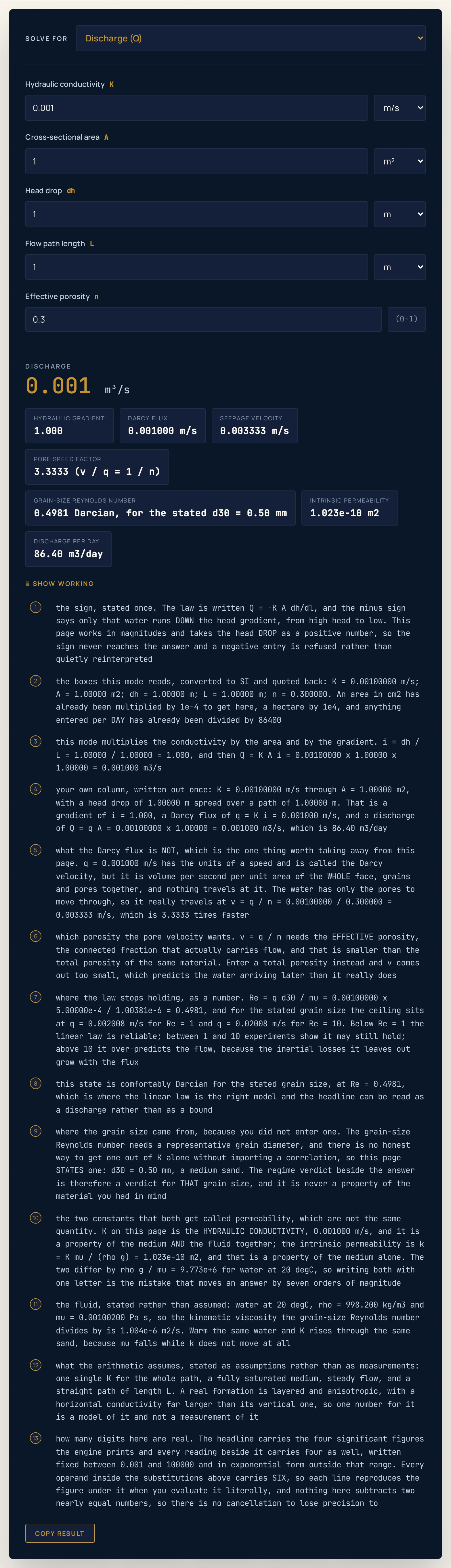
1.000, the flux is 0.001000 m/s — numerically the conductivity itself — and the discharge is 0.001 m3/s. The seepage velocity beside it is 0.003333 m/s, which is 3.3333 times larger, because the water has only 30 per cent of that face to move through.Worked example: change one thing at a time
The table starts at the opening column and moves one quantity at a time: the head drop up and down, the path length out, the gradient to zero, then the porosity, which moves the pore velocity while leaving the discharge exactly where it was. It then retypes the same column in different units, loads the five presets, runs the four backwards modes and ends on the entries the calculator declines.
Every answer, flux, velocity and verdict cell was taken from the running widget rather than worked out by hand, and where a cell and the tool ever part company, believe the tool. The verdict column is a verdict for the stated grain size of 0.50 mm in every row.
| Step | Solving for | What you type | Headline answer | Darcy flux | Seepage velocity | Grain-size verdict |
|---|---|---|---|---|---|---|
| The page as it opens: one square metre, a metre of drop over a metre of path | Discharge | K = 0.001 m/s, A = 1 m², dh = 1 m, L = 1 m, n = 0.3 | 0.001 m³/s | 0.001000 m/s | 0.003333 m/s | 0.4981 Darcian |
| Change ONE thing: double the head drop | Discharge | dh = 2 m | 0.002 m³/s | 0.002000 m/s | 0.006667 m/s | 0.9962 Darcian |
| Change ONE thing: halve it instead | Discharge | dh = 0.5 m | 0.0005 m³/s | 5.000e-4 m/s | 0.001667 m/s | 0.2491 Darcian |
| Change ONE thing: spread the same drop over ten times the path | Discharge | L = 10 m | 0.0001 m³/s | 1.000e-4 m/s | 3.333e-4 m/s | 0.04981 Darcian |
| Change ONE thing: take the head drop to zero (hydrostatic) | Discharge | dh = 0 m | 0 m³/s | 0.000 m/s | 0.000 m/s | 0.000 Darcian |
| Change ONE thing: the porosity down to 0.05, which the discharge ignores | Discharge | n = 0.05 | 0.001 m³/s | 0.001000 m/s | 0.02000 m/s | 0.4981 Darcian |
| Change ONE thing: the porosity up to 0.5 | Discharge | n = 0.5 | 0.001 m³/s | 0.001000 m/s | 0.002000 m/s | 0.4981 Darcian |
| The same area typed in square centimetres | Discharge | A = 10000 cm² | 0.001 m³/s | 0.001000 m/s | 0.003333 m/s | 0.4981 Darcian |
| The same conductivity typed in metres per day | Discharge | K = 86.4 m/day | 0.001 m³/s | 0.001000 m/s | 0.003333 m/s | 0.4981 Darcian |
| Preset: the sand column | Discharge | K = 0.001 m/s, A = 0.070686 m², dh = 1 m, L = 1 m, n = 0.3 | 7.069e-5 m³/s | 0.001000 m/s | 0.003333 m/s | 0.4981 Darcian |
| Preset: the clay liner, eight decades slower | Discharge | K = 1e-9 m/s, n = 0.45 | 7.069e-11 m³/s | 1.000e-9 m/s | 2.222e-9 m/s | 4.981e-7 Darcian |
| Preset: the gravel aquifer, a real cross-section | Discharge | K = 0.01 m/s, A = 150 m², L = 20 m, n = 0.25 | 0.075 m³/s | 5.000e-4 m/s | 0.002000 m/s | 0.2491 Darcian |
| Preset: the transition band, where the law gets shaky | Discharge | K = 0.1 m/s, dh = 0.5 m, L = 10 m | 0.0003534 m³/s | 0.005000 m/s | 0.01667 m/s | 2.491 Transition |
| Preset: past the Darcy limit, where the answer is a PREDICTION | Discharge | K = 0.1 m/s, dh = 2 m, L = 0.5 m | 0.02827 m³/s | 0.4000 m/s | 1.333 m/s | 199.2 Beyond Darcy |
| Backwards: the permeameter test, recovering the conductivity from the sand column | Hydraulic conductivity | Q = 7.0686e-5 m³/s, A = 0.070686 m², dh = 1 m, L = 1 m | 0.001 m/s | 0.001000 m/s | 0.003333 m/s | 0.4981 Darcian |
| Backwards: how large a cross-section the opening discharge needs | Cross-sectional area | Q = 0.001 m³/s, K = 0.001 m/s, dh = 1 m, L = 1 m | 1 m² | 0.001000 m/s | 0.003333 m/s | 0.4981 Darcian |
| Backwards: what head drop it needs | Head drop | Q = 0.001 m³/s, K = 0.001 m/s, A = 1 m², L = 1 m | 1 m | 0.001000 m/s | 0.003333 m/s | 0.4981 Darcian |
| Backwards: how long a path would spread that drop out enough | Flow path length | Q = 0.001 m³/s, K = 0.001 m/s, A = 1 m², dh = 1 m | 1 m | 0.001000 m/s | 0.003333 m/s | 0.4981 Darcian |
| A zero path length is declined | Discharge | L = 0 m | no answer | — | — | — |
| A zero porosity is declined | Discharge | n = 0 | no answer | — | — | — |
| A porosity of 1 is declined: that is an open channel, not a porous medium | Discharge | n = 1 | no answer | — | — | — |
| A zero head drop has no unique conductivity, so the inverse is declined | Hydraulic conductivity | dh = 0 m | no answer | — | — | — |
| An area small enough to make the answer an infinity is declined on the OUTPUT | Hydraulic conductivity | A = 1e-320 m² | no answer | — | — | — |
Rows 1 to 4 are the linearity of the law in four lines. Double the head drop and the discharge doubles exactly; halve it and it halves; spread the same drop over ten times the path and it falls to a tenth. The flux column tracks it in lockstep, because the area never moved.
Row 5 is the one entry the page deliberately does not refuse. A head drop of zero is a hydrostatic column: there is no gradient, so there is no flow, and 0 is the answer rather than an error. The verdict is still Darcian, because no flow at all is as Darcian as it gets.
Rows 6 and 7 are the point of having a porosity box at all. The headline and the flux do not move, because neither depends on n; the seepage velocity moves by a factor of ten between n = 0.05 and n = 0.5, from 0.02000 to 0.002000 m/s. The water goes faster through tighter pores for the same discharge, which is the whole of the 1/n factor.
Rows 8 and 9 are the unit check worth doing before trusting any figure here — 1 m2 and 10000 cm2 are one area, and 0.001 m/s and 86.4 m/day are one conductivity. Rows 10 to 14 load the five presets, across a factor of 1e8 in conductivity, and row 14 is the one to read twice: at a grain-size Reynolds number of 199.2 the linear law does not hold, so 0.02827 m3/s is what it predicts and not a flow that would occur. The real discharge there is lower.
Rows 15 to 18 run the four backwards modes on the sand column and on the opening state, and row 15 is the one that matters in practice: a permeameter test measures Q, and K = Q/(A·i) is how the conductivity comes out of it. Rows 19 to 23 are the refusals. A zero path length and a zero porosity are divisions by zero; a porosity of 1 is an open channel rather than a porous medium; a zero head drop has no unique conductivity, because every conductivity gives the same zero flow; and row 23 is declined on the answer rather than the entry, because 1e-320 m2 is a positive area while a discharge divided by it is not a number at all.
Formula and symbol reference
One relation does the work: Q = K·A·(dh/L), which rearranges to K = Q/(A·i), A = Q/(K·i), dh = Q·L/(K·A) and L = K·A·dh/Q. Written in full it carries a minus sign, Q = −K·A·(dh/dl), which says only that water runs down the head gradient; both tools in this pair work in magnitudes and take the drop as positive, so the sign never reaches a readout.
The two rows to read together are K and k. Capital K is the hydraulic conductivity in m/s and describes the medium and the fluid; lower-case k is the intrinsic permeability in m2 and describes the medium alone, which is why it does not change when the water warms up. Note that the same English word also names an entirely unrelated magnetic quantity, so on this page it is always “intrinsic permeability k, in m2”.
Three rows in the table are not boxes. i, q and v are all derived from the four you type, and ν is a stated constant for the fluid rather than anything you can enter.
| Symbol | Meaning | Unit | Values used on this page |
|---|---|---|---|
| Q | Volumetric discharge: the volume of water crossing the whole face per second | m3/s (menu: m3/s, L/s, m3/day) | Opens on 0.001 m3/s, which is 1.0 L/s and 86.4 m3/day. The presets reach 7.069e-11 and 0.07500 m3/s. |
| K | Hydraulic conductivity, capital K: how easily this fluid moves through this medium. A property of the two together | m/s (menu: m/s, m/day, cm/s) | Opens on 0.001 m/s, which is 86.4 m/day and 0.1 cm/s. The presets span 1.000e-9 to 0.1000 m/s, a factor of 1e8. |
| A | Cross-sectional area normal to the flow: the whole face, grains and pores together | m2 (menu: m2, cm2, ha) | Opens on 1 m2, which is 10000 cm2. The aquifer preset uses 150 m2, which is 1.5e+6 cm2 and 0.0150 ha. |
| dh | Head drop across the path: the difference between two hydraulic heads read against one datum | m (menu: m, cm, mm) | Opens on 1 m. The presets use 0.5, 1 and 2 m, and 0 is accepted while solving for the discharge. |
| L | Flow path length the head drop is spread over, measured along the path and not across the map | m (menu: m, cm, km) | Opens on 1 m. The presets use 0.5, 1, 10 and 20 m. |
| n | Effective porosity: the connected, flow-carrying fraction of the volume. Used only by the pore velocity | dimensionless, strictly between 0 and 1 | Opens on 0.3. The presets use 0.25, 0.3 and 0.45, and the worked table also sweeps 0.05 and 0.5. |
| i | Hydraulic gradient, i = dh/L: the whole of the geometry the law cares about |
dimensionless | A reading, not a box: 1.000 on the opening column, 0.05000 on the aquifer, 4.000 past the Darcy limit. |
| q | Darcy flux or specific discharge, q = K·i. Volume per second per unit area of the whole face — not a speed |
m/s | A reading: 0.001000 m/s on the opening column, 1.000e-9 in the clay liner, 0.4000 past the limit. |
| v | Seepage velocity, v = q/n: the speed the water in the pores really travels |
m/s | A reading: 0.003333 m/s on the opening column, 2.222e-9 in the clay liner, 1.333 past the limit. |
| k | Intrinsic permeability, lower-case k: k = K μ/(ρg), the medium alone with the fluid divided out |
m2 | A reading: 1.023e-10 m2 on the opening column, 1.023e-16 in the clay liner. It is K divided by 9.773e+6 for water at 20 °C. |
| Re | Grain-size Reynolds number, Re = q·d30/ν, at the stated reference grain size d30 = 0.50 mm |
dimensionless | A reading: 0.4981 on the opening column, 2.491 in the transition band, 199.2 past the limit. The bands are below 1, 1 to 10, above 10. |
| ν | Kinematic viscosity of the fluid, ν = μ/ρ: the quantity the grain-size Reynolds number divides by |
m2/s | A stated constant, not a box: 1.004e-6 m2/s for water at 20 °C, derived from ρ = 998.2 kg/m3 and μ = 0.001002 Pa·s. |
The physics: why the Darcy flux is not the speed of the water
The Darcy flux q = K·i comes out in metres per second and is traditionally called the Darcy velocity, and that name has misled more people than any other in groundwater work. It is a discharge divided by the whole area of the face — grains and pores together — so it is volume per second per square metre of something mostly solid. Nothing travels at it.
The water only has the pores to move through. If the connected pore space is a fraction n of the volume, the same discharge has to pass through n times the area, so it moves 1/n times faster: v = q/n. On the opening column that is 0.001000 m/s against 0.003333 m/s, a factor of 3.3333.
The direction of this error is the reason it matters. Use the flux where the pore velocity belongs and you predict a contaminant front crossing a liner more slowly than it will, by exactly the factor 1/n. That is not a conservative mistake: it says the water arrives later than it does, which is the wrong way round for anything safety-related.
The same relation, read the other way, is what makes a clay liner work at all. The liner preset has a conductivity of 1e-9 m/s, so its flux is 1.000e-9 m/s and its pore velocity 2.222e-9 m/s — still the larger of the two, but both so small that the liner buys years rather than days. The arithmetic of the travel time is one division, and it is done on the pore velocity, never on the flux.
The law is linear, and that is its other defining feature: double the gradient and the discharge doubles exactly, with no threshold and no curvature, all the way down to a gradient of zero. That is what rows 1 to 5 of the table above demonstrate, and it is also exactly what stops being true once the flow gets fast enough — which is what the grain-size Reynolds number beside the answer is there to tell you.
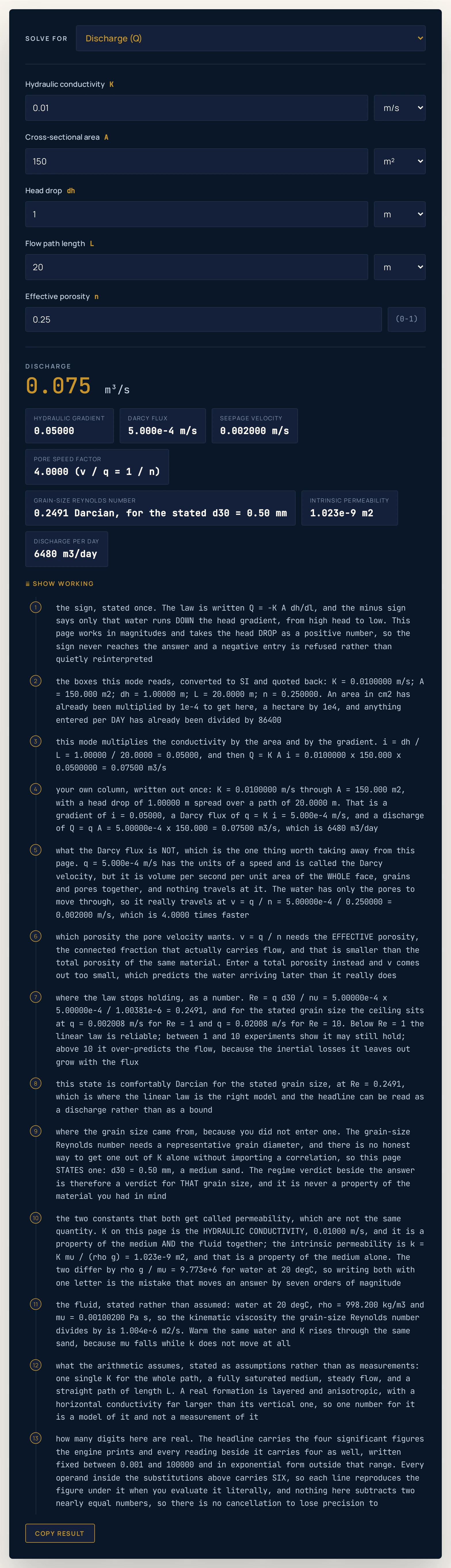
150 m2 cross-section at a gentle gradient of 0.05000 carries 0.075 m3/s, which the last reading turns into 6480 m3/day. The pore speed factor is 4.0000 here rather than 3.3333, because this preset's porosity is 0.25 — and the flux sits twice as far below the Darcian ceiling as the opening column did, at Re 0.2491 against 0.4981.Where Darcy's law breaks down
Every step on this page is one multiplication or one division, with nothing to accumulate and no cancellation to lose precision to. What goes wrong is physical, or it is a unit, and the first two items are the ones worth reading before anything else.
- Too fast: above a grain-size Reynolds number of about 1 to 10
- This is the hard ceiling. Below
Re = 1the flow is slow enough for the linear law to apply cleanly; experiments show it may still hold up to aboutRe = 10; above that, inertial losses the law omits begin to matter and it over-predicts the flow. For the stated grain size that ceiling is a flux of0.002008 m/satRe = 1and0.02008 m/satRe = 10. This grouping is built on a grain diameter, not on a pipe diameter — the pipe-diameter form is a different number, and the pipe-flow Reynolds number guide is where that one belongs. - Reading the Darcy flux as a speed: the fourth reading exists to stop that
- The Darcy flux has the units of a speed and is called a velocity, but nothing travels at it. Reading it as the pore velocity overstates every travel time by
1/n, which predicts arrivals later than they happen. The calculator prints both speeds and the factor between them so the substitution cannot be made silently. - The porosity box wants the effective value, not the total
v = q/nwants the connected fraction that actually carries flow. Total porosity counts dead-end and isolated pores as well, so it is larger, and using it makes the pore velocity too small in exactly the unsafe direction. The two can differ substantially in a fine-grained material.- One conductivity for a whole formation is a model, not a measurement
- Field conductivity is anisotropic — horizontal values are routinely far larger than vertical ones — and heterogeneous from metre to metre. A single
Kentered here describes an idealised uniform block. It is a useful idealisation and it is still only that. - The conductivity depends on the fluid; the intrinsic permeability does not
- Because
K = k·ρg/μ, warm water runs faster through the same sand than cold water does: the dynamic viscosity falls andKrises, whilekstays exactly where it was. So a conductivity measured with one fluid at one temperature cannot be carried over to another without converting throughk— which the sixth reading does for you. - Very low gradients in clays — verify before use
- A departure from linearity at very small gradients in clay-rich materials is sometimes reported, with a threshold gradient below which flow is said to be negligible. Neither source read for this page states it clearly, so it is listed here as verify before use and is not treated as fact anywhere on the page. The calculator applies the linear law at every gradient, including zero.
- It is a porous medium, not a pipe and not a channel
- Darcy's law needs a medium with a conductivity, not a wall with a roughness, and the pressure loss has to be proportional to the flow rate. For open-channel flow, use the Manning equation calculator instead — and note that its roughness coefficient is also written
n, which is not the porosity this page asks for. - The grain size is stated, so the verdict is conditional
- The regime word is computed at
d30 = 0.50mm, because no honest grain size can be recovered from a conductivity alone. In a gravel the same flux sits at a much higher grain-size Reynolds number and in a silt at a much lower one. Read the word as a verdict for the stated grain size, and nothing more. - The calculator measures nothing — you supply the numbers
- Four quantities go in, one relation is applied, and the answer describes the column you described. The five preset columns are illustrative values spanning the measured range of each material class; the inputs are our choice and only the outputs are computed, so none of them is a measurement of a real site.
Where the Darcy's law calculator is actually used
- Reading a permeameter test backwards
- A constant-head test measures a discharge through a known area at a known gradient; the conductivity is what you want out of it. Point Solve for at Hydraulic conductivity, type the measured discharge, and
K = Q/(A·i)is done for you. Row 15 of the table above is that calculation on the sand column. - Putting a discharge on an aquifer cross-section
- Load Gravel aquifer and the answer arrives in both the units the question gets asked in:
0.075 m3/sas a headline and6480 m3/dayas a reading. The area box takes hectares as well as square metres, because a formation cross-section rarely arrives inm2. - Checking how long water takes to cross a barrier
- Load Clay liner and read the seepage velocity,
2.222e-9 m/s, not the flux. Divide the thickness by that and you have the travel time; divide it by the flux instead and your answer is2.2222times too long. The six worked problems in the Darcy's law guide run that arithmetic both ways round so the difference is impossible to miss. - Finding out whether the linear law still applies at all
- Load Transition band and then Past the Darcy limit and watch the fifth reading go from
2.491 Transitionto199.2 Beyond Darcy. The second of those is the state worth understanding: the headline is still printed, and it is a prediction rather than a flow. - Taking an intrinsic permeability off the sixth reading
- Petroleum and soil-mechanics work quotes the medium alone, in square metres, while groundwater work quotes conductivity in metres per second. The sixth reading does that conversion on every answer: the opening column's
0.001m/s is1.023e-10m2, which isKdivided by9.773e+6. - Teaching the
1/nfactor with nothing to hide behind - Set every length to
1and the gradient is1.000, the flux is numerically the conductivity, and the discharge is numerically the flux. Then move the porosity alone and only the seepage velocity responds. The interactive physics lab library has the visual version of the same idea.
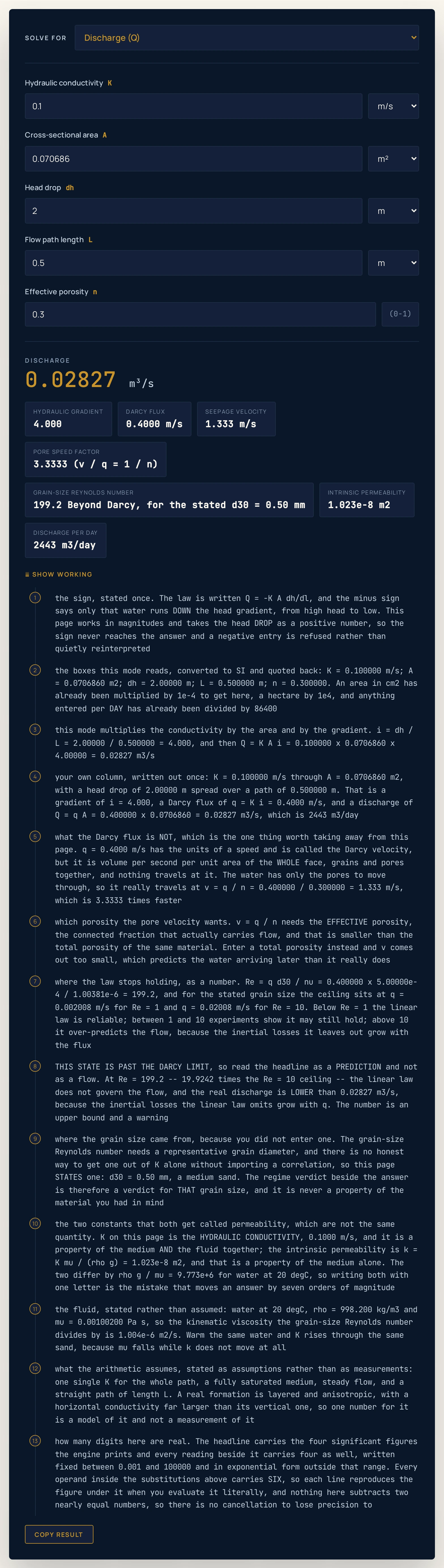
4.000 through coarse material the flux reaches 0.4000 m/s and the grain-size Reynolds number reads 199.2 Beyond Darcy — nearly twenty times the upper end of the usable band. The headline 0.02827 m3/s is therefore what the linear law predicts, not a flow that would occur, and the working says so in a step of its own.Where to go next
For the argument this arithmetic supports — the 1856 experiment, the two speeds, the ceiling and the six worked problems — read the Darcy's law guide, which this tool is the calculating half of.
Two tools sit next to this one for the problems it refuses. The Manning equation calculator handles open-channel flow, where a bed slope and a roughness replace the head gradient and the conductivity, and the friction factor calculator handles pressure loss along a pipe wall, which is the other quantity called Darcy.
The full physics lab library and the calculator index are open too.
Frequently asked questions
What does the Darcy's law calculator work out?
It runs Darcy's law in five directions: the discharge from the hydraulic conductivity, the area, the head drop and the path length, and each of those four back from a required discharge. Beside the answer it prints the hydraulic gradient, the Darcy flux, the seepage velocity, the factor between those two speeds, the grain-size Reynolds number with a regime word, the intrinsic permeability in square metres, and the same discharge in cubic metres per day. It computes no pressure, no pipe flow and no open-channel flow.
Why does the calculator print two different speeds?
Because they are two different quantities that both come out in metres per second. The Darcy flux is volume per second divided by the whole area of the face, grains and pores together, so nothing actually travels at it. The seepage velocity is the speed the water really moves, and it is larger by exactly one over the effective porosity, because the water only has the pores to move through. The fourth reading prints that factor so the two can never be confused.
What is the difference between the K and the k this calculator prints?
Capital K is the hydraulic conductivity in metres per second, and it describes the medium and the fluid together. Lower-case k is the intrinsic permeability in square metres, and it describes the medium alone. The two are related by k equals K times the dynamic viscosity divided by the density times gravity, which for water at 20 degrees Celsius is a factor of 9.773e+6. Warm the water and K rises on the same sand while k does not move at all.
Why does the calculator state a grain size I did not enter?
Because the grain-size Reynolds number needs a representative grain diameter, and there is no honest way to recover one from a hydraulic conductivity alone without importing a correlation. The page therefore states a reference grain size of 0.50 millimetres, a medium sand, and says so on every regime verdict it prints. Read the verdict as a verdict for that stated grain size. For a much coarser or much finer material the same flux sits at a different grain-size Reynolds number.
Why does one preset say its discharge is a prediction rather than a flow?
Because at that state the law no longer holds. The Past the Darcy limit preset reaches a grain-size Reynolds number of 199.2, which is 19.9 times the upper end of the band where the linear law is usable at all. The number the calculator prints is what the linear law predicts there, and the real discharge would be lower, because the inertial losses the linear law leaves out grow with the flux. The working says so in its own step whenever that state is reached.
Can I enter a head drop of zero?
Yes, while you are solving for the discharge, and the answer is exactly zero. A hydrostatic column has no gradient and therefore carries no flow, which is legal physics rather than an error, so the page returns a clean zero instead of refusing. The three modes that solve backwards for the conductivity, the area or the path length do need a head drop above zero: at a zero gradient every conductivity gives the same zero flow, so there is nothing unique for them to return.
Why does the calculator refuse a porosity of 0 or of 1?
Because the pore velocity is the Darcy flux divided by the porosity, and dividing by zero gives an infinity rather than an answer. A porosity of 1 is refused for a different reason: a volume that is entirely pore space is not a porous medium, it is an open channel, and Darcy's law does not describe one. The range is therefore open at both ends, and the box is the only one on the page that may be guarded before the solve branches, because it is never a solve target.
Where do the preset conductivity values come from?
They are illustrative values chosen to span the measured range of each material class, and they are not measurements of any named site. Real hydraulic conductivity varies by orders of magnitude within one material name, so a number for a real formation has to be measured rather than looked up. The five presets span a factor of a hundred million between the clay liner and the two fastest columns, which is the point of having them: the law is the same relation across all of it.
Does Darcy's law work for flow in a pipe or a stream?
No. It describes creeping flow through a porous medium, where the pressure loss is proportional to the flow rate, and it needs a hydraulic conductivity for the medium rather than a wall roughness. Open-channel flow is the Manning equation's problem, and its roughness coefficient n is not the porosity this page asks for even though both are written n. A pipe or a stream is a different problem with a different relation.
References & formula source
- The relation solved on this page is Darcy's law for flow through a porous medium: the volumetric discharge equals the hydraulic conductivity times the cross-sectional area times the hydraulic gradient, where the gradient is the head drop divided by the flow path length. The Darcy flux is the conductivity times the gradient, the seepage velocity is that flux divided by the effective porosity, and the intrinsic permeability is the conductivity times the dynamic viscosity divided by the density times gravity. Everything else on this page is one of those rearranged, or a quantity derived from the column they describe.
- Two sources were read for this page on 15 November 2026: the Wikipedia articles on Darcy's law and on hydraulic conductivity. Four things are taken from the first rather than paraphrased: that Darcy's law is only valid for slow viscous flow; that any flow with a grain-size Reynolds number less than one is clearly slow enough to be Darcian, while experimental tests have shown regimes with grain-size Reynolds numbers up to ten may still be Darcian; that the Reynolds number for porous media flow is expressed with the specific discharge and a representative grain diameter, for which the standard choice is the thirtieth-percentile size; and that the specific discharge, often called the Darcy flux or Darcy velocity, is not the velocity at which the fluid is travelling through the pores. The second source independently states the relation between hydraulic conductivity and intrinsic permeability that this page prints.
- Neither source, as read, yields a clean material-by-material table of conductivity ranges, so this page carries none and attributes none. The unit called the darcy carries no numeric value anywhere on this page, because its definition was not confirmed by either source and this page does not invent constants. The departure from linearity sometimes reported at very low gradients in clays is listed on this page as verify before use for the same reason.
- The constants are stated rather than derived: water at 20 degrees Celsius, a density of 998.2 kilograms per cubic metre and a dynamic viscosity of 0.001002 pascal seconds, with gravity at 9.81 metres per second squared. The kinematic viscosity the grain-size Reynolds number divides by is derived from those two and never typed, which is why this page prints 1.004e-6 square metres per second, the same value the Reynolds number tools on this site already print. The reference grain size of 0.50 millimetres is stated, not derived, and every regime verdict on the page carries that qualifier.
- Two independent reference scripts, written before this calculator existed and sharing no code with it, print every figure this page quotes. The first runs 88 checks with 0 failures on the underlying physics. The second extends it to this calculator's own states, runs 184 checks with 0 failures, and cross-checks every published string of the first one by re-deriving it: among other things it asserts that the pore velocity divided by the Darcy flux is exactly one over the porosity at every preset, that the intrinsic permeability inverts back to the conductivity it came from, that the permeameter inverse recovers the conductivity it started with, and that 164,160 rendered values across the whole reachable input space contain no infinity, no not-a-number and no character outside printable ASCII.
- One figure on this page is derived rather than quoted. The factor between the hydraulic conductivity and the intrinsic permeability, the density times gravity divided by the dynamic viscosity, works out at 9.773e+6 from the stated constants for water at 20 degrees Celsius, which is what this page prints. A rounded 9.78e6 is sometimes quoted instead and is 0.07 per cent high, which changes no printed answer, but the derived value is the one the arithmetic on this page actually uses.
- The five preset columns are illustrative configurations chosen to span the measured range of each material class, not measurements of any named aquifer, dam, landfill or laboratory test. Real hydraulic conductivity varies by orders of magnitude within one material name and has to be measured rather than looked up, and the preset names are shorthand for the configuration behind the button for that reason. Only the outputs are computed; the inputs are our choice.
- Every figure quoted in the prose and the tables above is either a string this calculator printed for the inputs named beside it, or one of the constants stated above, or a ratio the unit tests assert. Where a cell and the running widget ever part company, believe the widget. This page computes; it measures nothing.
- Further reading: Darcy's law — Wikipedia