Conductance G
29.76 S
A wire's resistance is set by its material and its shape, R = ρL/A. Drag the sliders below to change the length, cross-sectional area and temperature, switch between five metals, and watch the resistance, conductance and the current at 12 V respond in real time.
A wire's resistance is not just a number on a component — it is a shape. Set the metal, length, thickness and temperature and watch R = ρL/A, the conductance and the current at 12 V respond. A longer or thinner wire resists more; a colder or more conductive metal resists less.
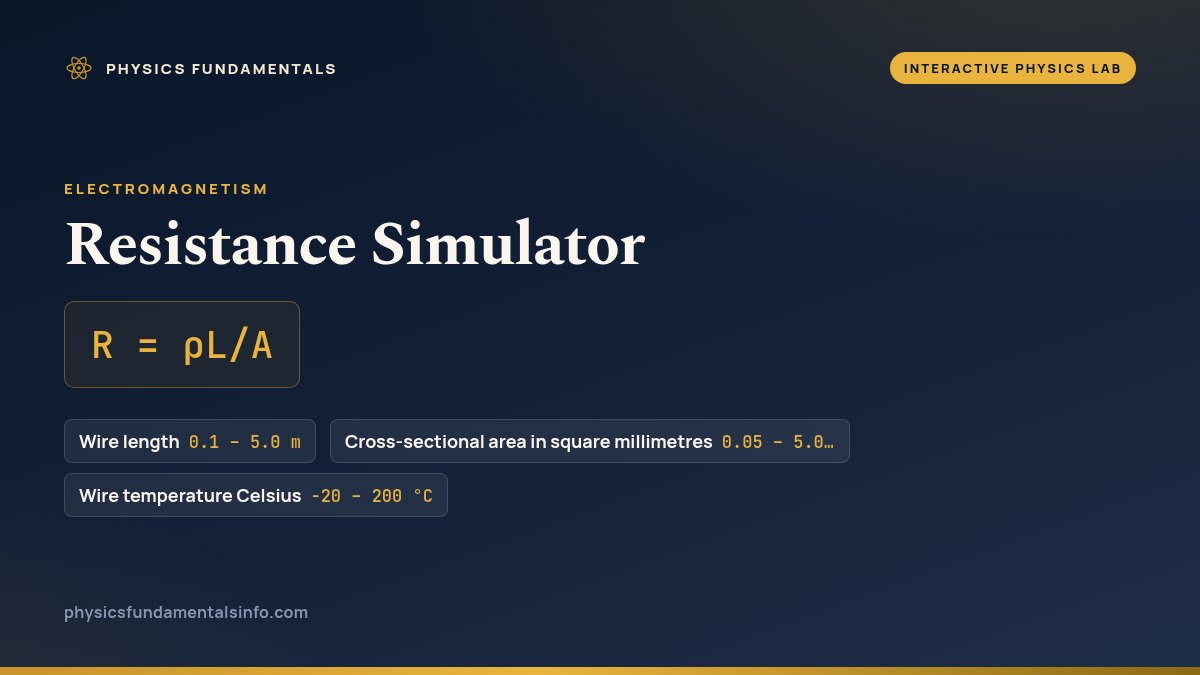
The resistance simulator is a free interactive physics lab that runs in your browser — nothing to install and no sign-up. Drag length, area and temperature, switch metals, and watch R = ρL/A and the current update live. It reports resistance as you drag the sliders.
| Control | Range | Step |
|---|---|---|
| Wire length | 0.1 – 5.0 m | 0.1 |
| Cross-sectional area in square millimetres | 0.05 – 5.0 mm² | 0.05 |
| Wire temperature Celsius | -20 – 200 °C | 1 |
This simulator turns R = ρL/A from a line of algebra into an object you can reshape. Each control feeds one part of the equation, and one readout answers first, so you can isolate exactly what does what. The five material buttons set the resistivity ρ; the Length slider stretches the wire; the Cross-section slider fattens or thins it; and the Temperature slider warms the metal, nudging its resistivity upward.
Move any one of them and the panel updates together. Drag Length to the right and the wire on the canvas grows longer while the resistance climbs in step — double the length, double the resistance — and because the supply is pinned at 12 V, the current readout drops by the same factor. Drag Cross-section instead and the wire visibly thickens while the resistance falls as 1/A; the conductance readout, being simply 1/R, rises as its mirror image. Switch from copper to nichrome and the resistance leaps about sixty-five-fold without the wire changing shape at all, because only ρ has changed. What the numbers prove, live, is that resistance is never one property — it is material and geometry multiplied together.
The slider that corrects the deepest misconception is Cross-section. It is tempting to think a thicker wire “pushes back” harder, but the simulator shows the opposite: more cross-sectional area gives charge more room to move, so a fatter wire resists less, not more. That is why household cables rated for heavy current are thick, and why a thin filament in a bulb runs hot. To put exact numbers to any wire, use the resistivity calculator or the Ohm's Law calculator; for the full theory read What Is Electrical Resistance? and the companion guide to Ohm's law, or open another model from the full simulation collection.
R = ρL/A assumes the current uses every square millimetre of the cross-section equally. That holds for direct current. Feed the same wire alternating current and it stops being true: the changing magnetic field inside the conductor pushes current out towards the surface. Using this simulator's copper resistivity of 1.68 × 10⁻⁸ Ω·m, the skin depth is about 9 mm at mains frequency but only about 65 micrometres at 1 MHz. At radio frequencies the middle of a thick wire carries almost nothing, the effective area is a thin shell rather than the geometric A, and the true resistance far exceeds what this page predicts, which is why RF conductors are litz wire or hollow tube.
The Temperature slider uses ρ(T) = ρ20(1 + α(T - 20)), a straight line fitted near room temperature. Push it far enough and the line stops describing metal. Extrapolate copper's α of 0.00393 downwards and it predicts zero resistivity at about -234 °C, which no copper wire has ever managed; real metals flatten onto a residual resistivity set by impurities and defects long before that. Upwards the line under-predicts instead, because α itself grows with temperature.
The Current I at 12 V readout divides 12 V by the wire's resistance alone, as though the wire were the whole circuit. Set copper to L = 0.1 m and A = 5.00 mm² and it reports R = 3.360e-4 Ω and I = 35,710 A. No 12 V supply delivers anything like that. What you have described is a dead short. The real current would be set almost entirely by what the formula ignores: the supply's internal resistance and the contact resistance of the terminals. Once the wire's own R falls to the same order as those, the readout becomes a wild upper bound.
Finally, length, area and temperature are three independent sliders here, and in a working circuit they are not independent at all. Current heats the wire at a rate I2R, the heat raises ρ, the higher ρ raises R, and the changed R alters the current again. The simulator has no such loop: set a temperature and it stays set. A real element settles where that feedback balances the heat it loses to the air, and it lengthens and thins slightly as it warms, shifting L and A too.
Sizing the copper in a building. Select copper, set L = 5.0 m and A = 2.50 mm², and the readout gives R = 0.0336 Ω. Resistance is proportional to length, so a 20 m run of that same cable is four times as much, about 0.134 Ω. Push 20 A through it and the cable itself drops roughly 2.7 V and dissipates about 54 W as heat inside the wall. That calculation is what wiring regulations enforce when they tie a cable size to a circuit rating and a maximum run length.
A toaster element. Switch the material to nichrome and set L = 2.4 m, A = 0.05 mm²: the resistance reads 52.8 Ω. On a 230 V mains supply an element of that resistance dissipates about 1.0 kW, which is a real toaster. Notice what the material button did: the geometry never changed, only ρ. Nichrome's 1.10 × 10⁻⁶ Ω·m against copper's 1.68 × 10⁻⁸ is the entire reason one metal is the element and the other is the flex feeding it, and nichrome's low α of 0.0004 keeps its resistance steady as it glows, so the power stays predictable.
Why filament lamps blow at switch-on. Choose tungsten, leave L = 2.0 m and A = 1.00 mm², and drag the temperature from 20 °C to 200 °C: the resistance climbs from 0.112 Ω to 0.2027 Ω, a factor of 1.81 for a 180-degree rise. A real filament runs far hotter than this slider reaches, so its hot resistance is over ten times its cold value. At switch-on the filament is still cold and low-resistance, so it draws a current many times its running value — which is why an incandescent bulb nearly always fails as it is switched on, not midway through the evening.
It changes the wire's cross-section — how thick it is when you cut straight across it — measured in square millimetres. In the formula R = ρL/A, the area A sits on the bottom, so a bigger cross-section means a lower resistance. Watch the wire on screen grow fatter as you drag the slider right, and the resistance readout falls in inverse proportion: double the area and the resistance halves.
Because resistance is proportional to the material's resistivity, and nichrome's resistivity is about 1.1e-6 ohm-metres against copper's 1.68e-8 — roughly sixty-five times larger. Keep the length, area and temperature fixed, switch the metal from copper to nichrome, and the resistance leaps by that same factor of about 65. That huge resistivity is exactly why nichrome is used for heating elements and copper for wiring.
The simulator drives the wire from a fixed 12 V supply, so the current follows I = V/R. Lengthening the wire raises its resistance (R is proportional to length), and a larger resistance at a fixed voltage means a smaller current. Drag the length slider and watch the two readouts move in opposite directions — R up, I down — a direct picture of Ohm's law at a constant voltage.
It models how a metal's resistivity rises as it heats up, using rho(T) = rho20 · (1 + alpha·(T - 20)), where rho20 is the resistivity at 20 degrees Celsius and alpha is the material's temperature coefficient. Raise the temperature and the resistivity — and therefore the resistance — climbs for all five metals, which is why an incandescent bulb's filament has a far higher resistance when glowing hot than when cold.
Yes. Conductance G is the reciprocal of resistance, G = 1/R, measured in siemens (S). It is simply the other way of describing the same thing: a low-resistance wire is a high-conductance wire, and vice versa. The simulator shows both so you can see them move as mirror images — anything that lowers R raises G by the same factor.