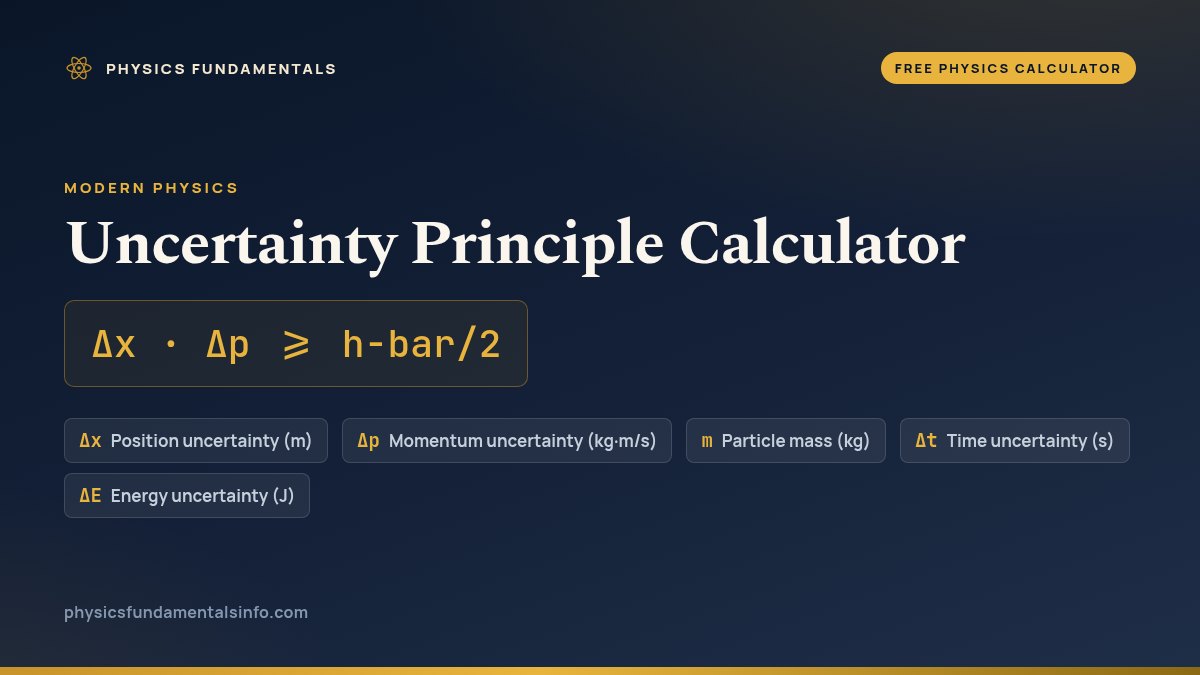
Heisenberg's uncertainty principle: a particle's position and momentum cannot both be sharp, and the product of their spreads has a floor, Δx · Δp >= h-bar/2. This free calculator solves all five rearrangements — momentum, position, speed, energy and time — and shows every step of the working.
What Is the Uncertainty Principle Calculator?
The uncertainty principle calculator is a free online tool built on the formula Δx · Δp >= h-bar/2. Enter the values you already know, in whichever units suit you, and it solves for momentum, position, speed, energy or time spread and shows every step of the substitution. Uncertainty Principle is the Heisenberg limit: Δp = h-bar/(2Δx), plus the energy–time form.
| Symbol | Quantity | Default unit | Also accepts | Example value |
|---|---|---|---|---|
| Δx | Position uncertainty | m | mm, um, nm, pm, fm | 1e-10 |
| Δp | Momentum uncertainty | kg·m/s | — | — |
| m | Particle mass | kg | — | — |
| Δt | Time uncertainty | s | ms, us, ns, ps, fs | — |
| ΔE | Energy uncertainty | J | eV | — |
How to calculate an uncertainty limit
The uncertainty principle sets a floor on how sharply two paired quantities can be known at once. For position and momentum that floor is Δx · Δp >= h-bar/2, where h-bar is the reduced Planck constant, 1.054571817×10⁻³⁴ J·s. A wave packet that achieves the bound exactly — a Gaussian — turns the inequality into an equality, and that equality is what this calculator solves: Δp = h-bar/(2Δx).
There are three steps. First, pick the mode that matches what you have: enter a position spread to get the momentum spread, a momentum spread to get the position spread, or a position spread and a mass to get the spread in speed. Second, enter your value and choose its unit — the calculator converts to SI before doing any arithmetic, so a hydrogen atom can be entered as 100 pm rather than 1e-10 m. Third, read the answer with the worked steps and the extra conversions underneath.
The single most common mistake is expecting the mass to change the momentum spread. It does not: Δp = h-bar/(2Δx) contains no mass at all, so an electron and a proton squeezed into the same width carry the same Δp. Mass only enters one step later, in Δv = Δp/m, which is why a heavy particle confined to an atomic width has a speed spread you would never notice. The momentum spread is really a spread of matter wavelengths; the De Broglie wavelength calculator turns any one of them into the wavelength it corresponds to, and the Uncertainty Principle Simulator draws both spreads at once so you can watch them trade off.
The same relation holds between energy and time, ΔE · Δt >= h-bar/2, but it means something different: a state that lives only briefly cannot have a sharply defined energy. That is the origin of the natural linewidth of a spectral line and of the width of an unstable particle's mass peak. For the full argument, including where Heisenberg's own microscope thought-experiment misleads, see the Heisenberg uncertainty principle explained.
Worked example
Confine an electron to a position spread of Δx = 1.0×10⁻¹⁰ m, about the width of a hydrogen atom. The momentum spread is Δp = h-bar/(2Δx) = 1.054571817×10⁻³⁴ / (2 × 1.0×10-10) = 5.27×10⁻²⁵ kg·m/s (to 3 s.f.). Dividing by the electron mass, 9.11×10⁻³¹ kg, gives a speed spread of about Δv = 5.79×10⁵ m/s — roughly 0.2% of the speed of light, which is why atomic electrons are genuinely fast-moving. On the energy–time side, a state that lives for Δt = 1.0×10⁻⁸ s has a minimum energy width of ΔE = 5.27×10⁻²⁷ J, which is 3.29×10⁻⁸ eV.
Why it matters
The uncertainty principle explains why atoms do not collapse, why the ground state of any bound system has an irreducible zero-point energy, why spectral lines have a natural width, and why an unstable particle's mass is quoted with a decay width. It also sets the scale of quantum confinement in semiconductors and quantum dots, where shrinking a structure raises the energy of its lowest state by exactly the mechanism this calculator quantifies.
Frequently asked questions
What units does the position uncertainty need?
Metres, internally. The calculator accepts metres, millimetres, micrometres, nanometres, picometres or femtometres and converts to metres before doing any arithmetic, so you can type 100 and pick pm rather than entering 1e-10 m. Atomic-scale problems usually sit in the picometre-to-nanometre band: a hydrogen atom is about 100 pm across, a nucleus a few femtometres.
Why do I get a bigger momentum spread when I enter a smaller position spread?
Because the two are inversely proportional. Δp = h-bar/(2Δx) puts Δx in the denominator, so halving the position spread doubles the momentum spread and their product stays fixed at h-bar/2. This is the whole content of the uncertainty principle: confinement is not free, and the tighter you pin down where a particle is, the less you can say about how fast it is going.
Does the mass field change the momentum spread?
No. Δp = h-bar/(2Δx) contains no mass at all, so an electron and a proton confined to the same width have identical momentum spreads. Mass only enters when momentum is converted to speed, Δv = Δp/m, which is why the speed mode asks for it and the momentum mode does not. A proton confined like an electron has the same Δp but a speed spread about 1836 times smaller.
What does the energy–time mode actually tell me?
It relates how long a state lives to how sharply its energy can be defined: ΔE·Δt = h-bar/2. A short-lived state cannot have a precisely defined energy, which is why unstable particles and excited atomic levels have a natural linewidth rather than a single sharp energy. Enter a lifetime and you get the minimum energy width that lifetime forces; enter a measured linewidth and you get the lifetime it implies.
Why does entering zero give no answer?
Every quantity here sits underneath a division, so zero would mean dividing by zero and an infinite answer. Physically that is the statement that a perfectly sharp position would demand an infinite momentum spread — a limit that no real particle reaches. The calculator returns a message rather than an infinity, and it treats negative and non-numeric entries the same way, since an uncertainty is a width and widths are positive.
References & formula source
- Eisberg & Resnick — Quantum Physics of Atoms, Molecules, Solids, Nuclei and Particles, chapter on the uncertainty principle.
- Griffiths — Introduction to Quantum Mechanics, section on the generalised uncertainty principle.
- NIST — Fundamental Physical Constants (CODATA), reduced Planck constant h-bar = 1.054571817 × 10^-34 J·s.
- Further reading: Uncertainty principle — Wikipedia