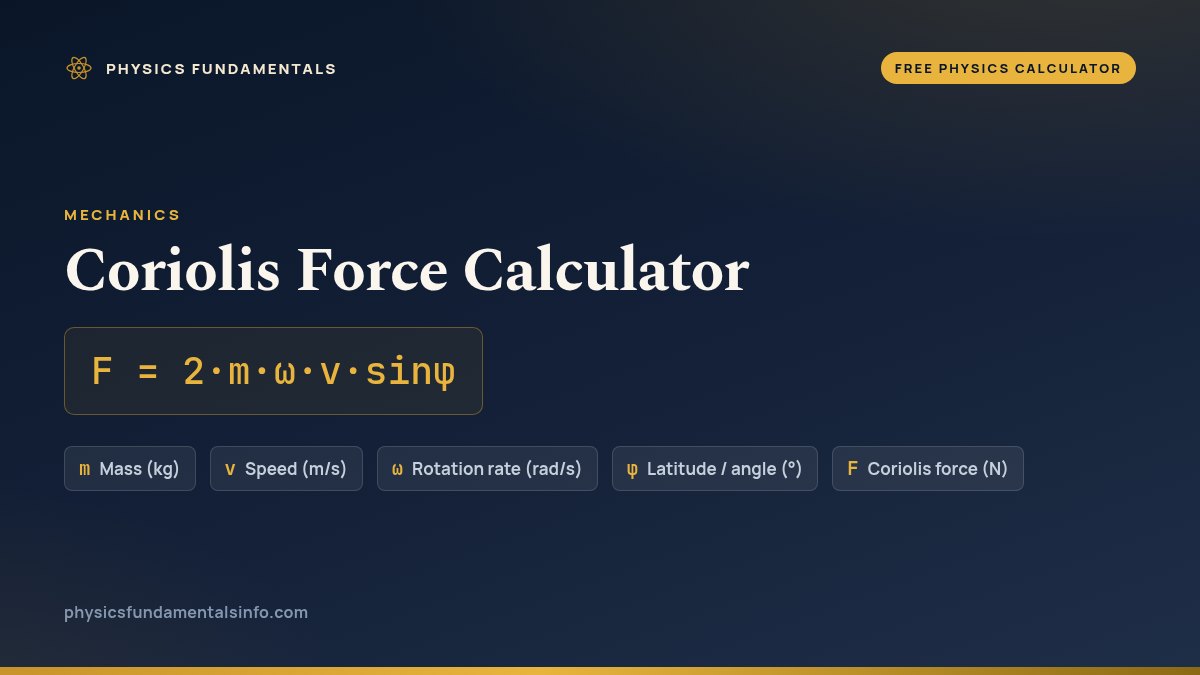
Coriolis force: the apparent sideways force on a moving object seen from a rotating frame, F = 2·m·ω·v·sinφ. This free calculator solves for the force, the mass, the speed or the rotation rate, and shows every step.
What Is the Coriolis Force Calculator?
The coriolis force calculator is a free online tool built on the formula F = 2·m·ω·v·sinφ. Enter the values you already know, in whichever units suit you, and it solves for coriolis force, mass, speed or rotation rate and shows every step of the substitution. Coriolis Force is the deflecting force felt in a rotating frame such as the spinning Earth.
| Symbol | Quantity | Default unit | Also accepts | Example value |
|---|---|---|---|---|
| m | Mass | kg | g, t | 1 |
| v | Speed | m/s | km/h | 10 |
| ω | Rotation rate | rad/s | °/s, rpm | 7.2921e-05 |
| φ | Latitude / angle | ° | rad | 45 |
| F | Coriolis force | N | mN, µN | — |
How to calculate the Coriolis force
In a frame rotating at angular velocity ω, an object of mass m moving at speed v feels an apparent deflecting force F = 2·m·ω·v·sinφ, where φ is the latitude — or, more generally, the angle between the velocity and the rotation axis. The factor of two and the sine term come straight from the vector cross product that defines the Coriolis acceleration in a spinning reference frame.
To use the calculator, enter the values you know. The default rotation rate is Earth’s, 7.29×10⁻⁵ rad/s, so for problems set on the spinning planet you can leave it as is and simply supply the mass, the speed and the latitude. Choose what to solve for from the menu, read the force in newtons, and check the worked steps that show the formula with your numbers substituted in. For the related inward force that keeps an object turning, see the circular motion calculator and the centripetal force calculator.
Worked example
Take a 1 kg mass moving at 10 m/s at latitude 45 degrees on Earth (ω = 7.29×10⁻⁵ rad/s). The Coriolis force is F = 2 × 1 × 7.29×10-5 × 10 × sin(45°), which is about 1.03×10⁻³ N. That is small for an everyday object, but spread over the vast scale of the atmosphere the same effect adds up and shapes the weather.
Why it matters
The Coriolis force sets the rotation of cyclones and anticyclones — counter-clockwise in the northern hemisphere, clockwise in the southern — and it steers ocean currents and the trade winds. Engineers must also correct for it in long-range artillery and rocketry, where a projectile’s flight is long enough for the deflection to matter. The force vanishes at the equator (sin 0 = 0) and is strongest at the poles. For the underlying spin rate, see the angular velocity calculator, and for definitions of the terms used here, the physics glossary.
Frequently asked questions
What is the Coriolis force?
The Coriolis force is an apparent (fictitious) force in a rotating reference frame that deflects moving objects sideways. Its magnitude is F = 2 m omega v sin(phi), where m is the mass, omega the rotation rate, v the speed and phi the latitude or the angle between the velocity and the rotation axis.
Why is it strongest at the poles and zero at the equator?
It comes down to the sin(phi) factor. At the poles (phi = 90 degrees) sin is 1, so the deflection is at its maximum, while at the equator (phi = 0) sin is 0, so there is no horizontal deflection there at all.
Does the Coriolis force really affect draining sinks?
No. On the scale of a basin the Coriolis force is far too weak compared with other effects such as the shape of the bowl and how the water was set in motion. It matters for large, long-lived flows like weather systems, not for bathtubs or toilets.
Is the Coriolis force a real force?
It is a fictitious or inertial force that appears only in a rotating frame. In an inertial frame nothing pushes the object sideways at all: it simply travels in a straight line while the ground turns beneath it, and that relative motion looks like a curved deflection.
What rotation rate should I use for Earth?
Earth turns once per sidereal day, which gives omega = 7.2921 x 10^-5 rad/s. This is the calculator’s default rotation rate, so for problems set on the spinning Earth you can leave it unchanged and just enter the mass, speed and latitude.
References & formula source
- Kleppner & Kolenkow — An Introduction to Mechanics, Chapter 9 (Non-inertial Systems and Fictitious Forces).
- Marion & Thornton — Classical Dynamics of Particles and Systems, Chapter 10 (Motion in a Non-inertial Reference Frame).
- Young & Freedman — University Physics with Modern Physics (rotating frames).
- Further reading: Coriolis force — Wikipedia