Wet-bulb temperature: the lowest temperature air can reach by evaporating water into it — what a wet thermometer reads. This free calculator estimates it from the air (dry-bulb) temperature and the relative humidity using Stull’s widely used empirical formula, with the result in Celsius or Fahrenheit.
What Is the Wet-Bulb Temperature Calculator?
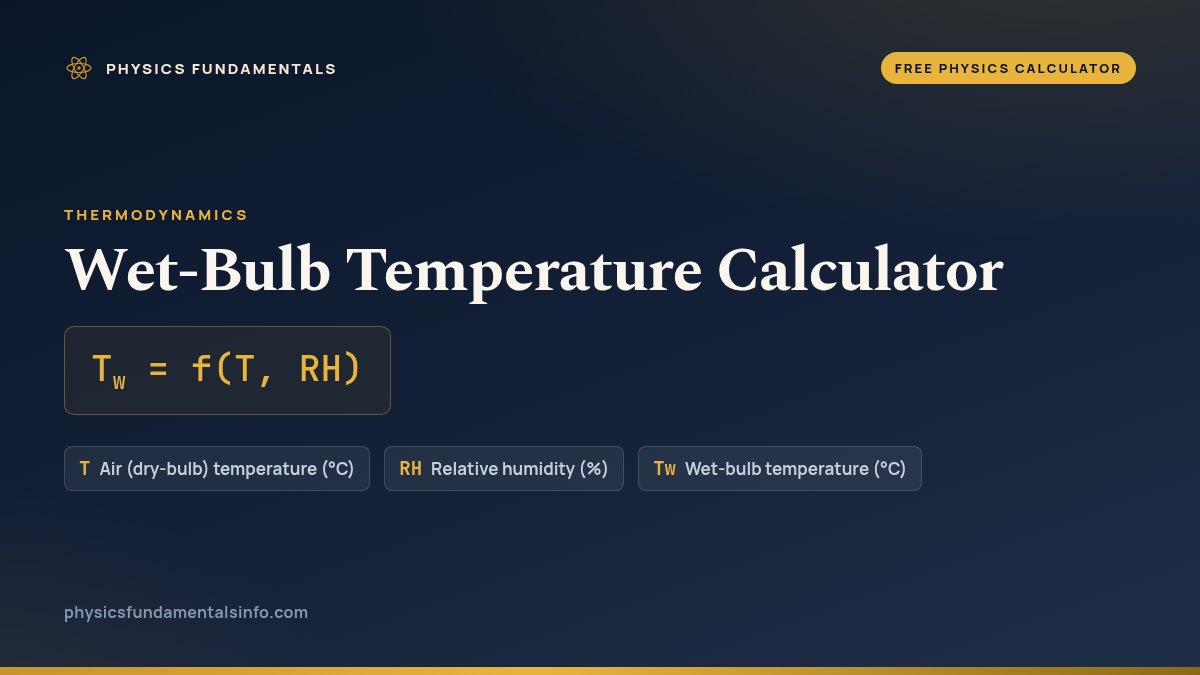
The Wet-Bulb temperature calculator is a free online tool built on the formula Tw = f(T, RH). Enter the values you already know, in whichever units suit you, and it solves for wet-bulb temperature from air temperature and humidity and shows every step of the substitution. Wet-bulb temperature from air temperature and relative humidity.
| Symbol | Quantity | Default unit | Also accepts | Example value |
|---|---|---|---|---|
| T | Air (dry-bulb) temperature | °C | °F, K | 30 |
| RH | Relative humidity | % | — | 50 |
| Tw | Wet-bulb temperature | °C | °F, K | — |
How to calculate wet-bulb temperature
The exact wet-bulb temperature depends on evaporative cooling and is not a simple algebraic formula, so this calculator uses Stull’s 2011 empirical fit, which is accurate to within a few tenths of a degree for ordinary conditions. Rather than solving the full psychrometric energy balance, the fit maps the air temperature and relative humidity directly onto the wet-bulb temperature.
To use it, enter the air (dry-bulb) temperature and the relative humidity as a percentage, then read the wet-bulb temperature. The relationship is intuitive once you try a few values: at 100% humidity the wet-bulb equals the air temperature, because the air is already saturated and no further evaporative cooling is possible. As the humidity falls, the wet-bulb drops further below the air temperature.
The wet-bulb temperature always sits between the dew point and the dry-bulb temperature, and it is central to psychrometrics — the study of moist air. It connects to other air properties you can explore with the gas density calculator, while the energy carried by evaporating water links back to the specific heat calculator. For the underlying terms, see the physics glossary.
Worked example
At an air temperature of 30 °C and 50% relative humidity, Stull’s formula gives a wet-bulb temperature of about 22 °C. That is several degrees below the air temperature — precisely the evaporative cooling that a wet surface, or sweating skin, can achieve under those conditions. Lower the humidity and the wet-bulb falls further; raise it toward 100% and the wet-bulb climbs to meet the 30 °C dry-bulb reading.
Why it matters
Wet-bulb temperature is the key measure of heat stress: a sustained wet-bulb near 35 °C is considered the survivability limit for humans, because sweat can no longer cool the body. It also governs cooling-tower and evaporative-cooler performance, cloud formation, and snow-making. It is always at or below the dry-bulb temperature and at or above the dew point — a set of bounds that makes it a robust indicator of how much cooling evaporation can still provide. The latent heat calculator quantifies the energy that evaporation removes in the process.
Frequently asked questions
What is wet-bulb temperature?
The wet-bulb temperature is the temperature a parcel of air reaches when it is cooled to saturation by evaporating water into it. It is what a thermometer wrapped in a wet wick reads once the evaporating water has cooled it as far as it can go.
How is it different from dry-bulb temperature?
The dry-bulb temperature is the ordinary air temperature that a normal thermometer reads. The wet-bulb temperature is lower whenever the air is not saturated, and the gap between the two grows as the relative humidity falls.
Why is a wet-bulb of 35 °C dangerous?
At a wet-bulb temperature near 35 °C the air is so warm and humid that sweat cannot evaporate fast enough to cool the body, so even healthy people at rest in the shade can overheat. It is widely regarded as the survivability limit for humans.
What formula does this use?
This calculator uses Stull’s 2011 empirical equation, which relates the wet-bulb temperature to the air temperature and the relative humidity. It is valid for roughly 5 to 99% humidity at sea-level pressure and is accurate to within a few tenths of a degree.
How does wet-bulb relate to the dew point?
The dew point is at or below the wet-bulb temperature, which is in turn at or below the dry-bulb temperature. All three are equal only at 100% relative humidity, when the air is fully saturated.
References & formula source
- Stull, R. (2011) — Wet-Bulb Temperature from Relative Humidity and Air Temperature, Journal of Applied Meteorology and Climatology, 50, 2267-2269.
- ASHRAE Handbook — Fundamentals (Psychrometrics).
- Young & Freedman — University Physics with Modern Physics, §17-18 (Heat and phase change).
- Further reading: Wet-bulb temperature — Wikipedia