Activation energy (Ea) is the minimum energy barrier a reaction must clear, found from how its rate constant changes with temperature via the Arrhenius equation. This free calculator finds Ea from two rate constants at two temperatures, or predicts a rate constant from Ea, with every step shown.
What Is the Activation Energy Calculator?
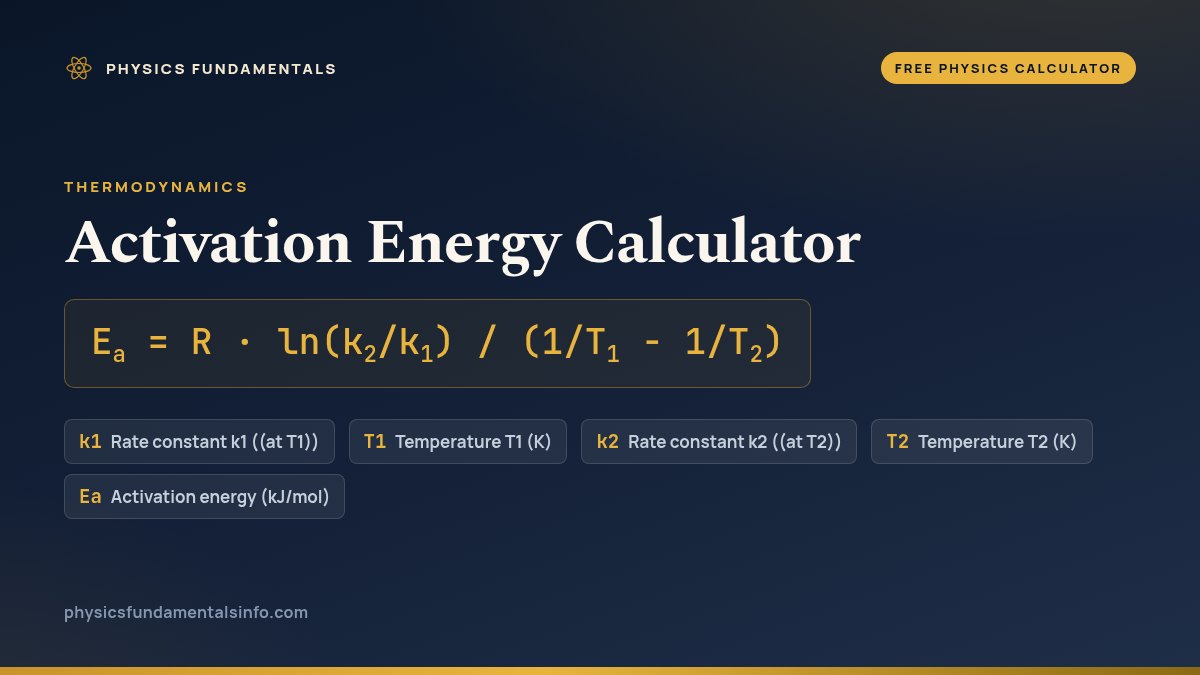
The activation energy calculator is a free online tool built on the formula Ea = R · ln(k2/k1) / (1/T1 − 1/T2). Enter the values you already know, in whichever units suit you, and it solves for activation energy or a rate constant and shows every step of the substitution. Arrhenius activation energy from two rate constants at two temperatures.
| Symbol | Quantity | Default unit | Also accepts | Example value |
|---|---|---|---|---|
| k1 | Rate constant k1 | (at T1) | — | 1 |
| T1 | Temperature T1 | K | °C, °F | 300 |
| k2 | Rate constant k2 | (at T2) | — | 2 |
| T2 | Temperature T2 | K | °C, °F | 310 |
| Ea | Activation energy | kJ/mol | J/mol, kcal/mol | — |
How to calculate activation energy
To calculate activation energy, use the two-point Arrhenius form, Ea = R × ln(k2/k1) / (1/T1 − 1/T2), where k1 and k2 are the rate constants measured at the absolute temperatures T1 and T2, and R = 8.314 J/mol/K is the gas constant. You need the rate constant at two different temperatures; the ratio of those constants tells you how strongly the reaction responds to heating, and that response fixes the size of the energy barrier.
There are three steps. First, decide whether you want the activation energy or a rate constant, and select it in the calculator’s Solve for menu. Second, enter both rate constants and both temperatures — you may type temperatures in kelvin, °C or °F, and the calculator converts them to absolute temperature before applying the law. Third, read the answer with the worked steps, which show the formula, your numbers substituted in, and the result in joules or kilojoules per mole.
A steep rise of rate with temperature means a large activation energy; a rate that barely changes with temperature means a small one. Because Ea sits inside an exponential, small changes in temperature can move the rate a great deal. For the heat released or absorbed once a reaction proceeds, see the enthalpy of reaction calculator, and for the thermodynamic limit on turning that heat into work, the Carnot efficiency calculator. For the term itself, see the physics glossary.
Worked example
A reaction whose rate constant doubles (k2 = 2 k1) as the temperature rises from 300 K to 310 K has Ea = 8.314 × ln(2) / (1/300 − 1/310). The bracket evaluates to about 1.075×10⁻⁴ K-1, so Ea ≈ 53 600 J/mol, or about 53.6 kJ/mol. This is a very typical value — it is exactly the region where a reaction rate roughly doubles for every 10 °C of warming.
Why it matters
Activation energy governs how strongly reaction rates depend on temperature — the basis of catalysis, which lowers Ea to speed a reaction; of food spoilage and drug shelf-life, which slow in a fridge; and of the familiar doubling of many reaction rates for each 10 °C rise. It links directly to collision theory and the Boltzmann factor e−Ea/RT, the fraction of collisions energetic enough to react, which in turn connects to the behaviour of gases described by the ideal gas law.
Frequently asked questions
What is activation energy?
Activation energy is the minimum energy needed for reactants to react. In the Arrhenius equation k = A e^(-Ea/RT), a higher Ea means a slower, more temperature-sensitive reaction, because fewer molecular collisions carry enough energy to clear the barrier.
How do I find Ea from two temperatures?
Use the two-point Arrhenius form Ea = R x ln(k2/k1) / (1/T1 - 1/T2), with the temperatures in kelvin and R = 8.314 J/mol/K. Measure the rate constant at two temperatures, take the ratio, and the equation returns the activation energy directly.
Why must temperatures be in kelvin?
The Arrhenius equation uses absolute temperature inside the exponential, so temperatures must be measured from absolute zero. Celsius or Fahrenheit values would give the wrong ratio and a wrong Ea. Convert first with K = C + 273.15; this calculator does that for you when you enter °C or °F.
How does a catalyst change activation energy?
A catalyst provides an alternative reaction pathway with a lower activation energy, speeding the reaction without being consumed. Because Ea sits in the exponential, even a modest reduction in Ea can multiply the rate constant many times over.
What are typical activation energies?
Many ordinary reactions fall between about 40 and 120 kJ/mol. Near 50 kJ/mol the rate roughly doubles for each 10 °C rise near room temperature, which is the familiar rule of thumb behind food spoilage and drug shelf-life.
References & formula source
- Atkins & de Paula — Physical Chemistry, Chapter 22 (Reaction Kinetics; the Arrhenius equation).
- Laidler — Chemical Kinetics, Chapter 4 (Temperature dependence of rate constants).
- Zumdahl — Chemistry, Chapter 12 (Chemical Kinetics).
- Further reading: Activation energy — Wikipedia