Efficiency formula physics reduces to one division: efficiency equals the useful output divided by the total input, multiplied by 100 for a percentage. The ratio carries no unit and never exceeds 1, and when stages run in series their efficiencies multiply rather than add or average.
Hand four stages in series the figures 38 %, 96 %, 92 % and 88 %, and only 29.53 % of the input survives to the far end. Nothing there is faulty. Three of those four pass on almost everything they are given, and the total still lands below thirty per cent.
That gap is where exam marks go, and where money goes. The division itself takes one keystroke; the judgement around it — which figure counts as the useful output, whether to add or to multiply, when to round — is the part worth learning. Everything below is built out of one division and the arithmetic that follows from it.
What Is Efficiency in Physics?
Efficiency is the fraction of what went into a device that came back out in the form you actually wanted, written as a decimal between 0 and 1 or multiplied by 100 and quoted as a percentage.
Two numbers go in. One is everything the device was supplied with; the other is the part of that supply which did the job you wanted done. Divide the second by the first and you are finished — and the answer comes out bare, with no joules and no watts clinging to it.
The published definition of energy conversion efficiency says the same thing: the ratio between a machine’s useful output and its input, in energy terms, with the result sitting somewhere between 0 and 1. The input and the output can be chemical, electrical, mechanical, light or heat, and the one requirement is that both are the same kind of quantity.
Why does a single fraction earn a name of its own? Because it is the only figure that lets you hold a kettle and a crane up against each other. Both sides have to be counted in the same unit before you can, and what a joule actually counts is where that counting starts.
Three claims carry the rest of this page, and each section below is the evidence for one of them.
- Claim 1. Efficiency is one division, and the arithmetic is never the difficult part. Choosing which figure is “useful” is, because that depends entirely on what the device is for.
- Claim 2. Stage efficiencies multiply. A chain of them is therefore never better than its worst single link, and is usually worse than it.
- Claim 3. A percentage handed to you has probably already been rounded, and multiplying a rounded percentage moves the answer in the second decimal place.
The Efficiency Formula
The efficiency formula is one division followed by one multiplication: divide the useful output by the total input, then multiply by 100 to read the result as a percentage.
- eta — the efficiency. A pure number with no unit at all, running from 0 to 1 inclusive; multiply by 100 to quote it as a percentage.
- E_useful — the useful energy output, in joules (J). The part of the supply that arrived in the form the device exists to deliver.
- E_input — the total energy input, in joules (J). Everything that went in, useful and wasted together.
- E_waste — the energy that did not arrive as the useful output, in joules (J).
- P_useful and P_input — the same two quantities measured as powers, in watts (W), over one shared interval.
- eta1, eta2, eta3, eta4 — the efficiency of each separate stage of a chain. Pure numbers.
- eta_total — the overall efficiency of the whole chain. Also a pure number.
The waste follows from the efficiency and needs no second measurement, which is worth knowing because the waste is usually the figure that changes a decision.
Work it by hand on paper the first few times, so the substitution becomes automatic, and then hand the two figures to the Efficiency Calculator, which runs the same relation in whichever of the three directions you are missing a number and prints the waste alongside the percentage. The table below applies it to four scenarios, each one a set of stated givens rather than a measurement of any real product.
| Scenario (all figures are stated givens) | Useful output | Total input | Efficiency | Wasted |
|---|---|---|---|---|
| a lamp, worked as powers | 9.000 W | 12.00 W | 75.00 % | 3.000 W |
| a kettle heating water | 167200 J | 190000 J | 88.00 % | 22800 J |
| a motor hoisting a load | 981.0 J | 1350 J | 72.67 % | 369.0 J |
| an ideal lossless device | 5.000 W | 5.000 W | 100.00 % | 0.000 W |
Read the last column rather than the fourth. A percentage is the kind of figure a reader half expects; the 22800 J going somewhere other than the water on the kettle row is not, and it is the number that would show up on a bill. Every row is worked line by line further down the page.
The simulator below pins the input at 1000 units and gives you the useful output as a slider, so the first stage’s efficiency is the definition itself sitting under your hand. Three more sliders add stages behind it, and the lab page that hosts this simulator adds eight preset buttons for the scenes this page works through, the four-stage chain among them.
Energy Form and Power Form Give the Same Number
Measure both quantities as energies in joules, or both as powers in watts, and the efficiency comes out identical — because a shared time interval sits above and below the line and cancels out of the ratio exactly.
Take a lamp given 12.00 W and delivering 9.000 W as light. The division gives 0.7500, which is 75.00 %. Now run the same lamp for 60.0 s: the light carries 540.0 J and the supply delivered 720.0 J, and 540.0 / 720.0 is 0.7500 again.
Nothing was approximated there. Multiplying both figures by the same 60.0 s multiplies the top and the bottom of one fraction by the same thing, so the quotient cannot budge. Double both sides, halve both sides, switch from seconds to hours — the answer is untouched.
In practice the power form is the one you meet first, because supplies are rated in watts. Getting a watt out of a measurement is a separate step that this page assumes you already have, and where a power comes from in the first place is the guide that does it.
One rule survives all of this: the two figures must be the same kind of quantity in the same unit. Joules over joules, watts over watts. Kilojoules over joules is the single commonest slip and it reads a thousand times out, with no warning in the answer to tell you.
Deciding Which Number Counts as Useful
The formula never decides which figure is the useful output — what the device exists to do decides it, and the very same joules can be the useful output in one problem and the waste in the next.
A lamp is for light, so the heat coming off it is waste. An electric heater is for heat, so that heat is the entire point, and the joules a lamp would be wasting are the ones you are paying for. Swap the device and the numerator moves, while the arithmetic sits perfectly still.
That is why a worked answer should name its numerator out loud. “Useful output = the gravitational energy gained by the load” is a line worth writing before you divide anything, and it is the line that stops a marker guessing what you meant. A common student slip is to divide by the output instead of the input, which gives a figure above 1 and ought to stop you on the spot.
The conversions themselves — which store of energy becomes which, and by what route — are a separate subject with its own page. The guide to energy conversion examples walks those and then hands over exactly this question: how much of the input arrives in the form you wanted.

Chains: Why Stage Efficiencies Multiply
Stage efficiencies multiply because each stage is handed only what the stage in front of it managed to pass on, so a chain can never beat its worst single link and almost always comes out below it.
Start with three stages, given as 40 %, 92 % and 85 %. The product is 0.400 times 0.920 times 0.850, which is 0.3128, or 31.28 % overall. That is below the 40 % stage, and the two good stages that follow the bad one did not rescue it — each simply took a further bite.
Now the scene that defeats every wrong intuition at once. Four stages, given as 38 %, 96 %, 92 % and 88 %: multiply the fractions and you get 0.29534208, which is 29.53 %.
Look at what that figure is not. It is not the first stage, it is not the average of the four, and it is nowhere near the three strong stages that follow the weak one.
One bad link sets the scale of the whole chain, and everything downstream can only shave what is left of it.
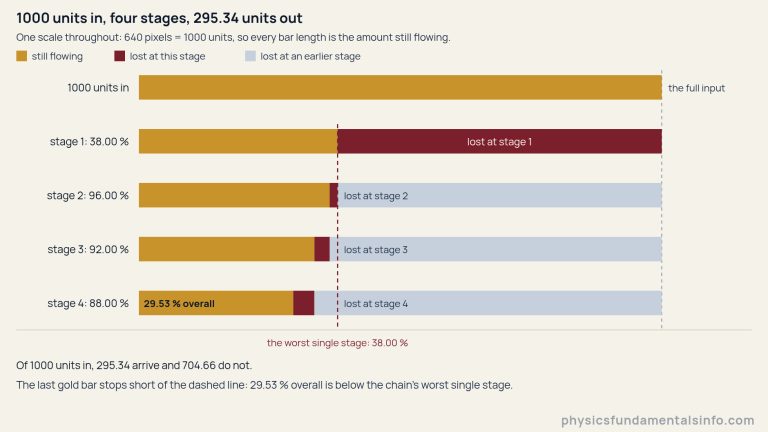
Say it in units rather than per cent and it stops being abstract. Put 1.000 MJ into that chain — 1000000 J — and 295342.08 J arrives while 704657.92 J does not. The percentage tells you how good the chain is; the second of those two numbers tells you what it costs.
One more property is worth noticing, because it is the one that makes chains easy to check: order is irrelevant. Multiplication does not care which stage you write first, so the same four numbers in any sequence give 0.29534208. A stage left at exactly 100 % multiplies by 1 and changes nothing, which is how you tell the arithmetic that a stage is not there.
Two Wrong Ways to Combine a Chain: Adding and Averaging
Adding stage efficiencies and averaging them are both wrong, and a two-stage case shows how badly: given 0.800 and 0.900, the overall figure is 72.00 %, not 170.00 % and not 85.00 %.
Adding fails first and fails loudly. 0.800 plus 0.900 is 1.700, and an efficiency above 1 would mean more came out than went in. Any answer above 100 % is the arithmetic telling you that you combined the stages wrongly, not that you have found a remarkable machine.
Averaging is the dangerous one, because it looks reasonable and lands in the right region. The mean of 0.800 and 0.900 is 0.8500, or 85.00 %, which is above the correct 72.00 % and — tellingly — above the weaker of the two stages. An overall efficiency can never be above the smaller of the two, and 72.00 % sits below it while 85.00 % sits above it.
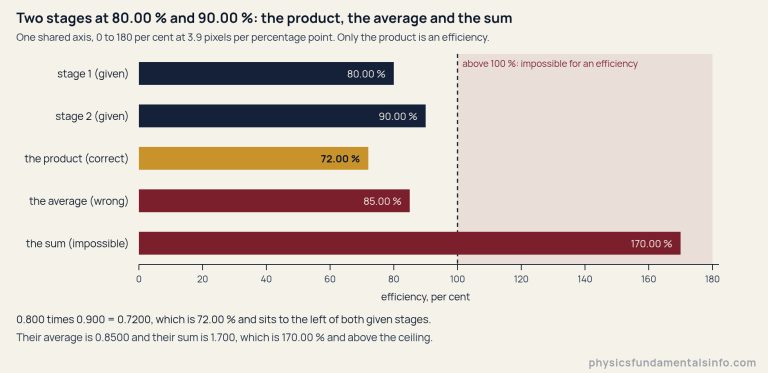
There is a quick sanity test here that costs nothing. Your overall figure must not be larger than any stage you multiplied, and if it is, you have added, averaged or dropped a stage. Check it before you check anything else.
Why Efficiency Can Never Pass 100 %
No device can exceed 100 %, and the reason is conservation of energy rather than anything subtler: you cannot draw more out of a supply than was put into it.
Exactly 100 % is a different matter — it is allowed, and it describes the ideal lossless device in the table above, where every joule supplied arrives as the useful output. Real devices fall short of it. The point is that the ceiling is arithmetic, not engineering: it would still be there in a universe with no friction.
So an efficiency above 1 is not a result but a signal. It means the useful output and the total input have been swapped, or they are not measuring the same thing, or a unit slipped by a factor of a thousand. The calculator for this page declines that combination in words instead of printing a figure, and the simulator cannot even be driven into that state, because its slider stops at the input.
Two neighbouring ratios wear the same word and are not this one. One belongs to mechanical advantage, where it compares the advantage a machine actually gives with the advantage its geometry promises, and it is not computed here. A heat engine carries a second and lower ceiling fixed by the two temperatures it works between — that is the Carnot efficiency, a separate calculation, and nothing on this page performs it.
And the apparent counterexample, the heat pump quoted above 100 %, is not a violation either. What gets quoted there compares heat moved against work supplied — two different quantities, so a different ratio with its own name, and no energy appearing from nowhere.
Where Rounding Bites
Multiplying percentages you have already printed shifts the result: two thirds of something at 0.850 comes to 56.67 %, while the same pair run through a stage printed first as 66.7 % comes to 56.70 %.
| Route through a two-stage chain | What is multiplied | Product | Printed as |
|---|---|---|---|
| chain the fractions, round once at the end | (2 / 3) times 0.850 | 0.5666667 | 56.67 % |
| chain the percentage you already printed | 0.667 times 0.850 | 0.56695 | 56.70 % |
The gap is 0.0283 percentage points. It hides completely in the first decimal place and is plainly wrong in the second, and it grows with every extra stage you chain the same way. The rule that fixes it is short: carry the fractions, round at the very end, once.
A second trap runs the other way. A device at 0.99949 prints as 99.95 % to two decimal places, which is honest, but as 99.9 to three significant figures — and a reader may well file that as lossless. It is not: 0.00051 of the input is still going somewhere. That is why nothing on this page quotes an efficiency to three significant figures.
Thirds deserve a mention because exam questions are full of them. One third is 33.33 % and two thirds is 66.67 %, both correctly rounded, and the two printed figures add to 100.00 % only because the rounding happens to go that way.
None of this is a rule about how many figures an answer deserves — that is a different question with its own answer. The question here is purely when in a chain you are allowed to round, and the answer is once, at the end.